

A global Spanish Real Estate market intelligence overview, with narrow focus on Costa Blanca
Spain’s real estate market is undergoing a structural transformation.
The traditional residential model, built around individual buyers and Build-to-Sell (BTS) promotion, is being systematically displaced by institutional capital deploying the “Living” framework: a category of assets valued primarily on their capacity to generate recurring, professionally managed income streams.
In 2025, the “Living” property sector in Spain captured €5 billion in investment, of which €3 billion corresponded to core residential assets.
International capital accounts for 60 to 70% of this flow, led by global operators such as Greystar, Hines, and Harrison Street.
This is not a cyclical peak. It reflects a decade-long structural convergence between European institutional appetite and Spain’s chronic housing supply deficit.
Key finding: Spain has compressed a European decade of “Living” sector evolution into four years. This shift is driven by the 2023 Housing Law and structural undersupply across all major markets.
1. Spain’s real estate transformation: From brick to operations
The term “Living” was codified by global consultancies (Savills, JLL, and CBRE) between 2015 and 2017 to classify real estate assets whose valuation depends not solely on land value but on their capacity to generate recurring income through a professionalised management model (the OpCo/PropCo structure).
Specifically, this distinction is fundamental because it links the operational structure directly to the property’s terminal value.
1.1 Decade-level market evolution
Over the past ten years, investment in the Living sector across Europe has grown from representing 12% of total real estate investment to exceeding 25%, directly competing with the Office sector for institutional allocation.
In Spain, this transition has been more abrupt, driven by two structural forces:
- A chronic structural supply deficit, particularly acute in Madrid, Barcelona, Málaga, and the Alicante province.
- A fundamental shift in labour mobility patterns, accelerating demand for non-traditional tenure formats (Flex Living, Co-living, Student Housing and Senior living condominiums).
1.2 Asset classification
The Living ecosystem encompasses 4 core subsegments, each with distinct risk/return profiles:
- Residential (core)
- Build to Sell (BTS)
- Build to Rent (BTR): Purpose-built residential for institutionally managed rental at scale. The highest-liquidity asset class within Living.
- Student housing (PBSA – Purpose-Built Student Accommodation): An inelastic asset class; demand is structurally decoupled from economic cycles. Spain is Europe’s leading Erasmus destination, with a bed deficit exceeding 30% in key cities.
- Flex Living / Coliving: Medium-term rental solutions (1–11 month contracts) targeting digital nomads, relocating professionals, and tech talent. Highest operational flexibility and inflation-linked upside.
- Senior Living: Active-ageing communities for the 65+ demographic, entirely distinct from the socio-health care sector. Driven by the Baby Boomer generation retirement wave and their high purchasing power.
2. Strategic context · Europe vs. Spain (2015→2025) · The rise of the ‘Living’ sector
Here is why this matters: The following data reveals a structural pivot that traditional metrics often miss, highlighting the speed of Spain’s institutionalization.
Spain’s evolution is particularly notable: the country has reproduced ten years of European institutional development in approximately four, a compression driven by regulatory change and pent-up structural demand (ready land scarcity and planning constraints, demographic shifts, asset mismatch, etc.).
Market impact
When structural demand is “pent-up,” it creates an environment characterized by:
- Low vacancy rates: Properties are absorbed rapidly due to the chronic lack of supply, helping to stabilize yields even in fluctuating economic conditions.
- Capital appreciation: The combination of scarcity and sustained interest consistently drives long-term value increases, which is a key metric for institutional asset performance.
- Yield compression vs. stability: While entry costs in areas like Costa Blanca South may offer higher immediate yields (5.5%–6.5%), structural demand in more supply-constrained areas tends to support more stable yields (4.5%–5.2%) over the long term.
| Segment | Europe 2015 | Europe 2025 | Spain 2015 | Spain 2025 |
| Residential (BTS) | 85% | 55% | 95% | 60% |
| Residential (BTS) | 5% | 20% | <1% | 15% |
| Student Housing | 6% | 12% | 2% | 12% |
| Flex Living / Coliving | 2% | 7% | 1% | 7% |
| Senior Living | 2% | 6% | 1% | 6% |
Consolidated from various sources: CBRE, JLL, Savills.
The key strategic indicator: while Germany and the Netherlands professionalised their rental markets over decades, Spain has replicated this shift in the past four years, creating asymmetric entry opportunities for international capital.
3. Prime yield matrix by subsegment and market (Madrid, Barcelona, Málaga, Balearic Islands and Alicante-Costa Blanca)
The following yield data represents the average of market analysis from CBRE, JLL and Savills.
- Lower figures indicate prime/core assets (capital protection focus).
- Higher figures indicate value-add or opportunistic real estate investments (growth focus).
The critical data for your 2026 allocation:
| Subsegment | Madrid | Barcelona | Málaga | Baleares | Alicante / Costa Blanca |
| Residential Build to Sell (BTS) | 4.0–4.5% | 4.2–4.7% | 4.5–5.0% | 3.8–4.3% | 4.8–5.5% |
| Residential Build to Rent (BTR) | 4.2–4.6% | 4.4–4.8% | 4.7–5.2% | 4.0–4.5% | 5.0–5.6% |
| Student Housing | 4.7–5.2% | 4.8–5.3% | 5.5–6.0% | N/A* | 5.8–6.5% |
| Flex / Coliving | 5.2–5.7% | 5.4–5.9% | 5.5–6.2% | 5.0–5.5% | 6.0–6.8% |
| Senior Living | 5.0–5.5% | 5.2–5.7% | 5.3–5.8% | 4.5–5.0% | 5.5–6.0% |
* Student Housing in the Balearic Islands is structurally limited by land scarcity. Demand is absorbed by mid-stay Flex Living products.
Notes on yield calculation: These figures reflect gross yield (€Annual rent / Total investment€).
- For cash buyers: Total investment = Purchase price + Taxes/Notary (~12–15%).
- For leveraged buyers (with mortgage): Consequently, using bank financing (e.g., 60% Loan-to-value ratio -LTV-) can double or even triple the cash-on-cash return. In the current market, a 6% gross yield often translates to a 12%+ return on equity once leverage is applied.
- Yield vs. Capital growth: These figures represent gross rental yields (income generation). They should not be confused with long-term capital appreciation (property value growth) or development margins (the profit generated by building and selling assets). Yields measure current cash-flow performance, not speculative upside or development returns.
- Residential BTS for personal use: These figures serve as a market health indicator, proving the (potential) enduring rental demand and investment quality of your property, rather than your intended use.
4. ‘Living’ subsegment deep dive: BTR, PBSA, Flex- and Co-living
4.1 Build to Sell (BTS) and Built to Rent (BTR): Core Residential
BTR represents the foundational layer of the “Living” pyramid.
BTS is clearly shifting to BTR. Following the pandemic, institutional capital, led by GIC, Greystar, and Ares, systematically displaced the local developer model.
From a negligible base in 2015, BTR now accounts for 15–20% of total annual real estate investment in Spain.
- Strategic rationale: the highest-liquidity asset class within Living.
Easiest exit for international funds. - National bed deficit creates structural demand floor, suppressing vacancy risk.
- Yield premium over prime offices: 75–100 basis points in most major Spanish markets.
4.2 Student housing (PBSA)
Spain is Europe’s leading Erasmus destination.
The structural bed deficit in Madrid, Málaga, and Alicante exceeds today 30%.
This makes Student Housing one of the most demand-inelastic asset classes available and performance is largely decoupled from broader economic cycles.
- Market leaders such as Harrison Street or GSA have moved the product from basic provision to integrated luxury complexes with full service offerings.
- Investment thesis: Furthermore, the gap between enrolled students and available institutional beds represents a durable, cycle-resistant arbitrage opportunity.
- Alicante city and province (University of Alicante, Universidad Miguel Hernández, Universidad Politécnica de Valencia – local delegations in Alicante): among the highest bed deficits in the Valencian Community, correlated with Distrito Digital expansion.
4.3 Flex living and co-living
The structural response to talent mobility.
Madrid, Barcelona and Málaga, followed by Alicante, are the primary beneficiaries of the digital nomad phenomenon, driven by Google and Oracle’s tech hub investments and, narrowing down to Costa Blanca, also incentivized due to Alicante’s Distrito Digital.
Contract structures (1–11 months) enable rapid rental adjustment in inflationary environments, providing an operational hedge unavailable in traditional residential.
- Highest operational flexibility of any Living subsegment.
- Inflation hedge: short contract cycles allow frequent rent resets.
- In the Costa Blanca, Benidorm (Marina Baixa) is emerging as Spain’s leading operational laboratory for Flex Living, converting obsolete hotel stock into mid-stay managed apartments.
4.4 Senior living
Senior living must be clearly distinguished from the socio-health care sector (nursing homes).
The focus here is active ageing: communities providing lifestyle services for autonomous adults aged 65+.
The European ‘Baby Boomer’ cohort, retiring within the next decade with high purchasing power and a preference for Mediterranean climates, represents the most demographically certain demand trend in Spanish real estate.
- Primary opportunity zones: Alicante/Costa Blanca, Balearics, Málaga/Costa del Sol.
- Target investor demographic: European HNWI and Family Offices (German, British, Nordic).
- Highest Senior Living concentration: Alicante province, with 10% of the provincial capital’s subsegment, reflecting the mature European buyer base.
5. Regional spotlight: Why Alicante province / Costa Blanca leads the operational shift
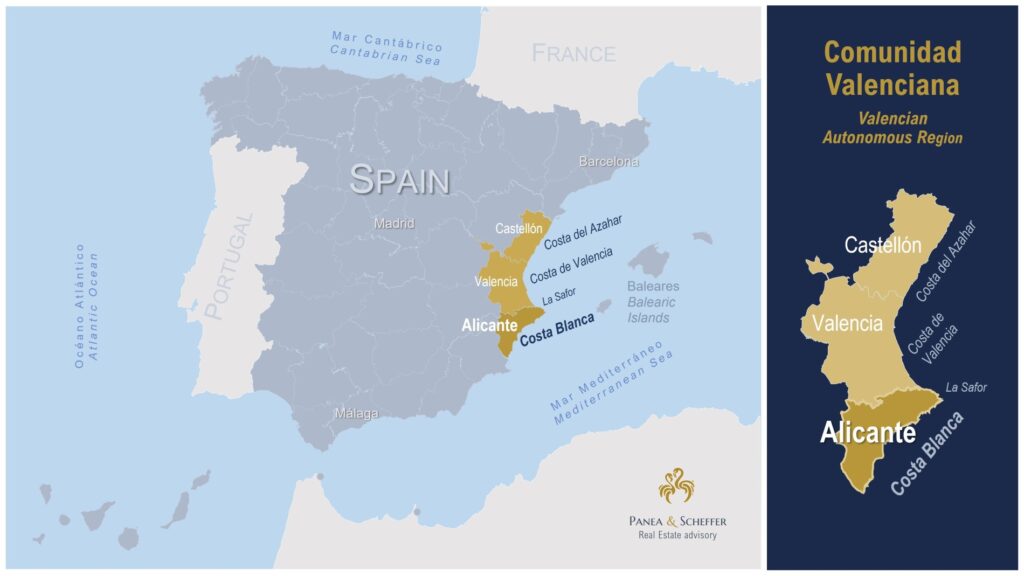
The province of Alicante within the Valencian Autonomous Region presents a structural market anomaly within the Spanish landscape.
It is traditionally the province with the highest proportion of foreign buyer transactions in Spain, today exceeding 40% in many comarcas (regions within the province), which creates an upward distortion in BTS (Build-to-Sell) weight relative to Madrid or Barcelona.
Simultaneously, this foreign buyer density creates a unique Senior Living opportunity without equivalent in any other Spanish province.
5.1 Subsegment weight by comarca (2025)
| Segment | Alicante city and surroundings | Marina Baixa (Benidorm) | Marina Alta (Jávea/Dénia) | Vega Baja (Torrevieja) |
| Residential BTS | 62% | 65% | 80% | 85% |
| Residetial BTR | 12% | 8% | 4% | 3% |
| Student Housing | 10% | 2% | 1% | <1% |
| Flex / Coliving | 10% | 15% | 8% | 4% |
| Senior Living | 6% | 10% | 7% | 8% |
5.2 Yields by comarca (2025→2026)
Alicante province yields are structurally higher than Madrid or Baleares, reflecting a more competitive land acquisition cost base that attracts Value-Add capital seeking returns above 5%.
The range within the province is significant, understanding this intra-provincial yield spread is critical for optimal capital deployment.
| Subsegment | Alicante city and surroundings | Marina Baixa | Marina Alta | Vega Baja |
| Residential (BTS) | 4.8–5.5% | 4.5–5.2% | 3.5–4.2% | 5.5–6.2% |
| Residential (BTR) | 5.0–5.6% | 4.8–5.4% | 4.2–4.8% | 5.8–6.5% |
| Student Housing | 5.8–6.5% | 6.0–6.8% | N/A | 6.5–7.0% |
| Flex / Coliving | 6.0–6.8% | 6.5–7.2% | 5.5–6.5% | 6.2–7.0% |
| Senior Living | 5.5–6.0% | 5.8–6.3% | 4.8–5.5% | 5.5–6.2% |
5.3 Comarca-level investment tesis
L’Alacantí – Alicante city and surroundings (Technology axis)
- The Flex Living and Student Housing growth trajectory is directly correlated with the expansion of Distrito Digital and the Universidad de Alicante (San Vicente del Raspeig).
- The student bed deficit is among the highest in the Valencian Community, creating a durable demand-supply gap.
- The BTR market is maturing rapidly as the capital city professionalises its residential offer.
Marina Baixa (Operational Model: e.g. Benidorm)
- Benidorm is emerging as Spain’s primary laboratory for Flex Living.
- The city’s existing service infrastructure, unrivalled hospitality, transport connectivity and excellent medical services, provides the operational scaffolding that Flex Living products require.
- Institutional investors are converting obsolete hotel stock and ageing residential into managed mid-stay apartments targeting European “energy nomads” and remote workers.
Marina Alta (Core/Trophy: Moraira-Dénia)
- Marina Alta (Moraira-Jávea-Denia) behaves structurally analogously to the Balearic Islands.
- Yields are compressed because asset values are high and vacancy risk in the premium BTS segment is negligible.
- Protected mountain ranges, planning restrictions prohibiting high-rise development, and the absolute scarcity of developable land create natural barriers to entry that protect capital against inflation and oversupply.
Vega Baja (Torrevieja)
- Vega Baja offers the province’s highest potential gross yields due to its more accessible entry price.
- While this attracts value-add investors targeting 6–7% returns, it requires a nuanced approach: local rental demand can be highly seasonal, and conventional markets are competitive.
- The Flex-living sector here is a standout opportunity (6.5–7.0%), but success depends on partnering with specialist operators who understand the area’s unique, internationally-driven buyer profile.
6. Key market drivers and risks
6.1 Structural demand drivers
- Housing Law 2023: Regulatory intervention has reduced speculative BTS activity, redirecting institutional capital toward professionally managed Living products.
- Demographic pressures: population growth concentrated in urban and coastal areas; increasing household formation at smaller unit sizes.
- International talent mobility: Spain’s quality of life premium relative to cost continues to attract European and American professionals, sustaining Flex Living demand.
- Tourism-residential hybridisation: the convergence of long-stay tourism and residential demand creates new rental archetypes, particularly in the Costa Blanca and Costa del Sol.
- Sovereign lifestyle migration: Beyond domestic trends, the international “Silver” generation, particularly from Northern Europe and North America, is increasingly seeking Southern Europe as a strategic safe haven. Driven by a desire for autonomy and superior quality of life in the face of more stringent fiscal environments at home, retiring baby-boomers provide a stable, long-term demand floor for prime coastal residential assets.
6.2 Risk considerations
- Regulatory risk: regional rent control measures (Catalonia precedent) require monitoring, although the Valencia region currently maintains a favourable regulatory environment.
- Operational risk: Living yields are highly sensitive to management quality. Market data indicates that the performance spread between highly optimized assets and those with fragmented or reactive management can often exceed 100–150 basis points, making the selection of a specialist operator a primary determinant of long-term returns.
- Liquidity risk: Value-Add and Opportunistic assets (Student Housing, Senior Living) have longer hold periods and more specialised buyer pools. Exit strategies must be ideally structured at acquisition.
- Interest rate sensitivity: Euribor stabilisation at 2.15–2.35% (Bank of Spain 2026 projections) supports investment case. Upward deviation above 3.0% would compress net yields materially.
8. Sources and reference authorities
This report draws on the following primary sources for data validation and due diligence:
- CBRE Research España – Real Estate Market Outlook Spain 2026.
- PwC / Urban Land Institute – Annual Emerging Trends in Real Estate Europe, a key reference for institutional investors.
- Savills España – Living sector investment data.
- Knight Frank – The Wealth Report – Analysis of HNWI and Family Office behaviour in luxury and residential assets.
- JLL Real Estate Outlook – Global trends in residential and Living sector real estate.
- XII Jornada IESE Real Estate – Expert consensus yield panel providing an authoritative national benchmark.
- BNP Paribas Real Estate – Analysis of logistics and Living sector trends in the Mediterranean arc.
- Ministerio de Vivienda (Spain) – Official statistics on real estate transactions and assessed property values.
- Cátedra Inmobiliaria Universidad de Alicante – Market intelligence for Alicante province, including comarca-level analysis.
- CaixaBank Research – Macroeconomic analysis of the Spanish real estate sector.
- INE / Eurostat – Demographic statistics, population projections and household data.
This report is prepared for general information and analysis, aimed at Real Estate investment in Spain. All yield data represents market consensus as of Q4 2025 and Q1 2026 from all consulted sources and should in any case be validated against any given transaction evidence for specific asset due diligence.
FAQ
Unlike traditional Build-to-Sell (BTS) residential, the other “Living” assets (BTR, Student Housing, Flex/Co-living) are valued as operational businesses (OpCo/PropCo structure). While BTS returns are realized at the point of sale, Living assets prioritize recurring Net Operating Income (NOI). When analysing these, look beyond gross yield; consider the operational alpha, the management team’s ability to maintain high occupancy and reset rents frequently (common in Flex Living). For HNWIs, leveraging bank financing (typically 60% LTV) in the current interest rate environment can often turn a 6% gross yield into a 12%+ cash-on-cash return, provided the operator mitigates vacancy risk.
The Costa Blanca offers an asymmetric risk-reward profile. While Madrid and Barcelona offer lower yields (4.0%–4.5%) due to high demand and scarcity, they are often “crowded trades.” The Alicante province, specifically the Distrito Digital axis around Alicante city, offers higher prime yields (5.0%–6.8%) driven by a structural undersupply of professionalized housing. The thesis here is driven by diversification: the Marina Alta area mimics the Balearic Islands’ “trophy asset” scarcity, while the Marina Baixa (Benidorm) acts as an “operational laboratory” for converting older hospitality stock into high-demand Flex Living units for the growing digital nomad and remote-work demographic.
While the national Housing Law of 2023 significantly altered the BTS landscape, the primary risk for investors is regional regulatory fragmentation. Investors should prioritize markets within regions with “business-friendly” regulatory interpretations of national law, such as the Valencian Community, compared to the more restrictive precedents seen in Catalonia. To hedge against regulatory volatility, focus on asset types with higher operational flexibility, such as Flex Living (1–11 month contracts), which generally fall outside the scope of traditional, long-term rent-control regulations. Always perform deep due diligence on the actual management history of any operator to ensure they can maintain the 100 to 150-basis-point performance spread that separates optimized assets from reactive ones.


Join The Discussion