
commercial Director
Berkshire Hathaway Homeservices Costa Blanca · Altea
Nearly one in every two properties sold in Alicante province last year was bought by a foreigner. No other province in Spain comes close.
A recent interview published by idealista/news featured an observation from Bruno Rabassa, CEO of Berkshire Hathaway HomeServices Spain, that resonates deeply with what we witness every day on the ground: ‘Spain has become Europe’s Florida, a privileged destination for international living, retirement, investment and relocation‘.
From my position in Altea as Commercial Director at Berkshire Hathaway Home Services Costa Blanca, I share that vision entirely.
The statistics, and the daily reality of working with buyers from across four continents, suggests the local tale is even more interesting.
The Costa Blanca is not simply a place where people come to retire. Over the decades, it has become one of Europe’s most genuinely international residential ecosystems. And the numbers, drawn from six decades of sustained demand, tell a remarkable story.
Spain’s demographic transformation: What the data actually shows
To understand the Costa Blanca today, it helps to step back and look at Spain’s broader demographic arc.
According to the Spanish National Statistics Institute (INE), Spain’s foreign resident population stood at fewer than 275,000 people in 1965, and under 700,000 people in the late 1990s. By January 2025, that figure had reached 6.91 million, representing 14.1% of the total population of 49.1 million. In the most recent quarterly data available (October 2025), the number had climbed further to 7.13 million.
In practical terms, Spain’s international resident population has multiplied by 26 in 6 decades and more than tenfold within a single generation.
The Comunidad Valenciana, home to the Costa Blanca, recorded the highest relative population growth of any Spanish region in 2025, at 2%, driven almost entirely by international arrivals.
This transformation has not been evenly distributed across the country. Some regions have emerged as true international hubs. Few more so than the province of Alicante.
Six decades in the making: How history built a market
What makes Alicante province genuinely exceptional is not merely recent interest, it is the depth and duration of what came before.
British, Dutch, Belgian, German and Nordic elite communities began enjoying the region as early as the 1890s, arriving initially as seasonal visitors drawn by climate and therapeutic tradition.
By the 1960s, that seasonal presence had evolved into something more permanent. Distinct national enclaves emerged naturally along the coast: certain urbanisations became predominantly British, others Dutch and Belgian, French, German or Scandinavian, each organised around shared languages, social networks and cultural habits that made permanent relocation feel accessible and familiar.
International schools, community associations and international supply networks reinforced that sense of home, at the Mediterranean.
Over the following decades, successive waves of resales, new developments and generational transitions gradually dissolved those boundaries.
Buyers from Eastern Europe joined the market in growing numbers from the 1990s onwards.
The mosaic grew denser, more layered, more international.
That long arc of settlement is not merely historical colour. It is the structural foundation that explains everything that follows in the data.
A market built over six decades does not behave like a speculative market. It has depth, liquidity, established infrastructure and a self-reinforcing international community that continues to attract successive generations of new buyers, including, increasingly, those arriving from North and South America.
Bruno Rabassa’s description of Spain as Europe’s Florida captures an important truth. But from where we stand on the Costa Blanca, the story has been building for far longer than any single comparison suggests.
What the data confirms, and what we observe daily on the Costa Blanca, is a market that has evolved well beyond its origins, towards something more sophisticated, more global and considerably more interesting.
The numbers behind the market
According to the General Council of Notaries of Spain, foreign buyers accounted for 18.4% of all residential property purchases nationwide in the second half of 2025, a proportion that, while slightly lower than recent peak years, remains extraordinarily high by European standards.
In Alicante province alone, the figures are in a different league entirely. According to the 2025 Anuario of the Colegio de Registradores de la Propiedad, 43.29% of all residential property transactions in the province were completed by foreign buyers in 2025, the highest proportion of any province in Spain, and almost three times the national average of 13.82%.
That share has been on a steady upward arc: in 2021 foreign buyers represented approximately one in three transactions, reaching 43.29% in 2025.
Alicante recorded 53,385 transactions in total, placing it third nationally by volume behind only Madrid and Barcelona. Across Spain as a whole, international buyers completed close to 97,500 transactions in 2025, a new historic high.
The buyer profile is broad and structurally diverse. Nationally, British, German and Dutch buyers continue to lead by share, with EU nationals representing over 57% of all foreign demand.
In Alicante specifically, this pan-European base has remained a constant across decades, giving the market a resilience that destinations dependent on one or two source countries simply cannot replicate.
What has shifted most visibly in recent years is the growing presence of buyers arriving from outside Europe entirely, a trend explored in the following section.
That diversity is not merely interesting. It is structural. When one market slows, another accelerates. The result is a residential ecosystem with a resilience that few Mediterranean destinations can match.
The new wave: North America and Latin America
One of the most significant shifts of recent years has been the growing presence of buyers from across the Atlantic.
Historically, North American purchasers represented only a modest proportion of international demand on the Costa Blanca. Today, that picture is changing, a trend also highlighted by Bruno Rabassa in his interview with idealista.
Remote working models, geopolitical uncertainty, healthcare considerations, lifestyle priorities, Living Sector investment and increasing awareness of Spain as a long-term destination have all contributed to rising interest from the United States, Canada and Latin America.
Many arrive expecting a Mediterranean retirement destination. What they discover is frequently something broader: a place where they can continue running businesses, work remotely, educate their children, access excellent healthcare, and enjoy a significantly lower cost of living than comparable destinations in North America or Northern Europe.
This is where a comparison often emerges, with either Florida or California, as frequently unprompted by our increasing American buyers. The Costa Blanca offers a similar combination of coastal lifestyle, top-tier healthcare, international culture, business infrastructure, year-round climate and personal freedom, at a dramatically different cost structure.
Livin in Costa Blanca: Beyond retirement, a more complex set of buyer profiles
One of the most persistent misconceptions about Spain’s international property market is that it is driven primarily by retirees.
Retirement remains an important component of demand, and Europe’s ageing demographics continue to provide a powerful structural tailwind.
The Baby Boomer generation is entering retirement with unprecedented levels of wealth and mobility, and Spain consistently ranks, statistically, among their preferred destinations, with the Costa Blanca as a favourite since decades.
Yet retirement alone no longer explains the market we observe.
Today’s international buyer on the Costa Blanca is just as likely to be an entrepreneur relocating a business, a technology professional working remotely, an international executive establishing a European base, an investor diversifying geographically, or a family seeking access to international education and a healthy lifestyle the whole year round. For many, the decision involves several of these motivations simultaneously.
The Costa Blanca increasingly attracts people who are not ending a chapter.
They are beginning one.
Why Costa Blanca continues to outperform
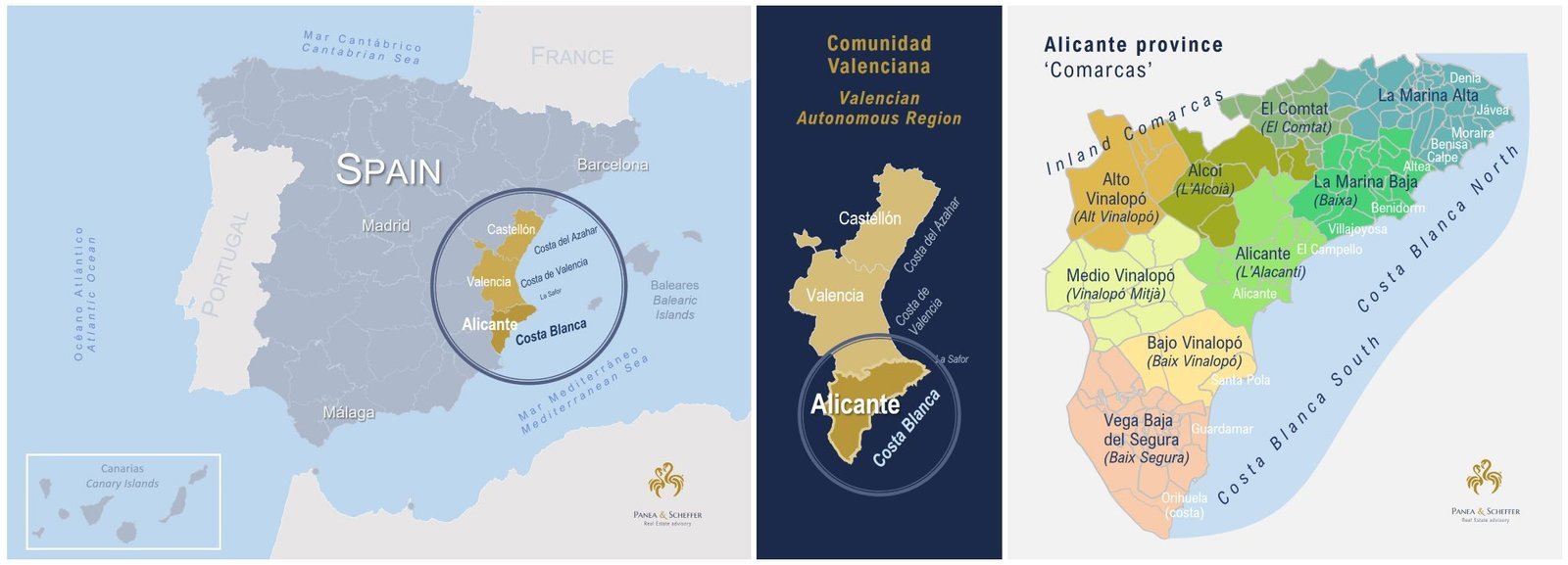
In terms of Real Estate geographies, within the Alicante province itself, the Costa Blanca is not a homogeneous market.
Alicante province, with an average price> oscillating between 1750 and 1850 €/m² (with high contrast between inland and coastal areas), is best understood as three distinct residential territories, each with its own buyer profile, price dynamics and investment logic.
Costa Blanca North
The Northern coastal region comprises three comarcas with meaningfully distinct characters:
1. La Marina Alta
Jávea, Dénia, Moraira, Teulada, Benissa, Pedreguer and the valleys connecting coast to interior, is where the dynamics change most fundamentally.
Jávea and Moraira maintain since several years the highest price in this comarca, followed by Calpe and Denia.
Protected landscapes, strict planning controls, limited buildable land and topographical constraints create a natural ceiling on supply that has no parallel elsewhere on the Costa Blanca.
These characteristics increasingly resemble the dynamics traditionally associated with the Balearic Islands: scarcity-driven, resilience-oriented, structurally resistant to correction.
1. La Marina Baja
Benidorm, Villajoyosa, Altea, Calp and their surrounding municipalities, occupies a middle ground that is frequently underestimated.
Benidorm’s transformation from a mass tourism destination into a genuine year-round urban market, anchored by The Lab innovation hub (BeCiTi) and a growing Flex Living and co-living ecosystem, is one of the more interesting structural shifts currently underway in the province.
Calp and Altea, architecturally distinctive, culturally rich, increasingly premium, occupy the upper end of this corridor’s price range.
2. Alicante
Anchored by Alicante city (capital of the province), San Juan and El Campello, it bridges the provincial capital with the coastal corridor heading north.
The area combines urban services and connectivity with growing international residential appeal, functioning as both a primary historic residential market for the local population and an increasingly popular base for foreign residents who value urban infrastructure alongside proximity to the coast.
Costa Blanca North is the area that Berkshire Hathaway HomeServices Costa Blanca calls home, and the reason is precisely the structural distinction between the Comarcas and Municipalities within.
Costa Blanca South
Encompassing the Bajo Vinalopó (Elche, Santa Pola, Crevillent) and the Vega Baja del Segura (Torrevieja, Orihuela Costa, Guardamar, Pilar de la Horadada) this is the province’s engine of volume.
Torrevieja alone consistently ranks among the highest-transaction municipalities in Spain, leading the province by number of “compraventas” (Sale-purchase agreements), attracting a broad spectrum of Northern and Eastern European buyers drawn by accessibility, value and a well-established international community.
Orihuela Costa and Guardamar follow a similar profile. This is a market defined by breadth and price accessibility.
The inland comarcas
Medio and Alto Vinalopó, Hoya de Alcoy, el Comtat and the interior valleys bordering the coastal comarcas, represent a third dynamic: more affordable, increasingly explored by buyers seeking rurality, authenticity and value-driven residential alternatives at significant distance from coastal price pressure.
This is an emerging story, one that deserves its own dedicated analysis.
Each of these territories will be the subject of future articles in this series.
Where the premium market actually sits: Q1 2026
In this article, however, the focus is Costa Blanca North, and deliberately so.
The table below illustrates the point precisely. Of the top twenty municipalities by premium ceiling price in Q1 2026, the majority sit within Costa Blanca North.
| # | Region / Comarca | Municipality / Specific Area | General Average Price (1T 2026) | Individual Maximum Ceiling (Premium Product 2026) | Type of Maximum Registered |
| 1 | Marina Alta | Moraira (Teulada) | 4.513 €/m² | 7.500 – 8.200 + €/m² | Luxury villas in Cap Blanc / Portet |
| 2 | Marina Alta | Jávea / Xàbia | 4.072 €/m² | 7.200 – 7.900 + €/m² | Premium single-family homes in Portichol / Balcón al Mar |
| 3 | Alicante | Alicante (Cabo de las Huertas) | 2.764 €/m² (M) | 5.700 – 7.200 + €/m² | Detached villas and chalets on the beachfront |
| 4 | Marina Baja | Benidorm (Playa de Poniente) | 3.610 €/m² | 6.500 – 7.100 + €/m² | Penthouses in exclusive towers (Intempo, Delfin Tower) |
| 5 | Marina Baja | Altea (Altea Hills / Mascarat) | 3.464 €/m² | 6.200 – 6.800 + €/m² | Contemporary villas with panoramic views |
| 6 | Marina Alta | Calpe | 3.519 €/m² | 5.800 – 6.400 + €/m² | First line of La Fossa and Arenal-Bol |
| 7 | Alicante | Alicante (PAU 5 / San Juan Playa) | 2.764 €/m² (M) | 4.500 – 6.300 + €/m² | Recent new construction and exclusive residential developments |
| 8 | Marina Alta | Benissa (Costa) | 3.580 €/m² | 5.500 – 6.100 + €/m² | Unique properties in Cala Advocat / Fustera |
| 9 | Marina Baja | Finestrat (Benidorm Hills) | 3.368 €/m² | 5.500 – 6.000+ + €/m² | New build villas in Sierra Cortina |
| 10 | Marina Baja | Villajoyosa (Playa Paraíso / Cala) | 3.539 €/m² | 4.800 – 5.400 + €/m² | Premium residential complexes facing the sea |
| 11 | Marina Alta | Dénia (Las Rotas) | 3.361 €/m² | 4.700 – 5.200+ + €/m² | Traditional and modern villas in the southern zone |
| 12 | Alicante | El Campello (Muchavista) | 3.407 €/m² | 4.600 – 5.200 + €/m² | Penthouses and single-family homes on the beachfront |
| 13 | Vega Baja del Segura | Orihuela Costa (Cabo Roig / Campoamor) | 2.926 €/m² | 4.400 – 4.900 + €/m² | Large single-family villas on the cliff |
| 14 | Marina Alta | Benitachell (Cumbre del Sol) | 3.307 €/m² | 4.300 – 4.800 + €/m² | Luxury residentials built on the hillside |
| 15 | Vega Baja del Segura | Pilar de la Horadada (Mil Palmeras) | 3.377 €/m² | 4.200 – 4.600 + €/m² | Modern villas on independent plots |
| 16 | Bajo Vinalopó | Santa Pola (Gran Alacant – Muelle) | 2.981 €/m² | 3.800 – 4.300 + €/m² | Single-family homes with sea views (Cliff) |
| 17 | Marina Baja | Alfaz del Pi (El Albir) | 3.049 €/m² | 3.900 – 4.400 + €/m² | Prime apartments and villas near the Boulevard |
| 18 | Marina Alta | El Verger | 3.303 €/m² | 3.600 – 4.000 + €/m² | Townhouses and new construction developments booming |
| 19 | Vega Baja del Segura | Guardamar del Segura (Pinada/Playa) | 2.786 €/m² | 3.500 – 3.900 + €/m² | High-end homes with protected views |
| 20 | Marina Alta | Els Poblets | 2.919 €/m² | 3.400 – 3.800 + €/m² | Single-family holiday properties next to the coast |
(M) Pondered average for the whole municipality.
Premium Real Estate in Costa Blanca
For buyers at the premium end of the market, the characteristics described for Costa Blanca North matter considerably more than short-term rental yields or market cycles.
They are not simply acquiring property. They are making a long-term positioning decision: lifestyle quality, capital preservation, access to infrastructure and community, and the flexibility to live internationally without compromising on any of those factors.
The infrastructure supporting that decision has developed in parallel: Modern airports with direct connections across Europe and beyond; international schools; private healthcare; world-class gastronomy; marinas, year-round outdoor living…
A community that, after six decades of international settlement, has the depth and diversity to feel genuinely like home, regardless of where home was before.
Ready to take the next step?
| For international buyers Relocate, invest or live on the Costa Blanca Whether you are planning a permanent move, a lifestyle investment or a long-term European base, my team and I work with international buyers across the full spectrum of the Costa Blanca market, from Alicante city to Denia, coastal and inland. Our team speaks your language, understands your priorities and knows this market in depth. We will guide you through every step, from the first conversation to the keys in your hand. |
| For premium property vendors Sell your property with confidence, speed and discretion If you are considering selling your home on the Costa Blanca, you deserve access to the full breadth of international demand this market attracts. Confidential, professional and results-driven, starting from an objective valuation of your property, definition of commercial strategy and pre-selection of qualified candidate-buyers. Because your property deserves nothing less. |
Frequently asked questions (FAQ)
The data does not support a peak narrative. According to the Observatorio del Turismo Residencial de la Costa Blanca, foreign buyer transactions in Alicante province increased 254% between 2010 and 2024, with a further 1% rise in 2024 alone despite a more challenging global environment. More meaningfully, the structural drivers, demographic demand from an ageing Northern European population, the growth of remote working, and the entry of North American and Latin American buyers, show no sign of reversing. Spain’s Living Sector attracted €5 billion in institutional investment in 2025 alone, growing at four times the European average. This is not a cyclical trend. It reflects structural demand meeting structural undersupply.
The Northern Comarca, Marina Alta (Altea, Moraira, Jávea, Dénia), operates with dynamics closer to the Balearic Islands than to conventional coastal markets. Land scarcity, planning restrictions and protected landscapes create a natural ceiling on supply, which has historically translated into strong long-term capital preservation. Gross yields in the area range from 3.5% to 4.8% depending on subsegment, lower than other parts of the province but backed by Balearic-style scarcity dynamics. For investors prioritising capital protection and lifestyle quality over maximum yield, it remains one of the most compelling markets in southern Europe.
The buyer base is broader and more diverse than at any previous point in the market’s history. British, Dutch and Belgian buyers continue to lead by volume, each accounting for more than 3,000 transactions in 2024 according to notarial data. German, Polish, French and Scandinavian buyers follow. What has changed most visibly in recent years is the growing presence of buyers from North America (the United States, Canada and Mexico) alongside Latin American buyers from Colombia, Argentina and Venezuela. Many are entrepreneurs, technology professionals or families seeking a long-term European base rather than a traditional retirement destination.
Americans are increasingly choosing the Costa Blanca, in Spain, for a combination of lifestyle, security and long-term value. The region offers many of the qualities associated with coastal California or South Florida -sunshine, outdoor living, international communities and excellent healthcare -but with a significantly lower cost of living and ownership.
Safety is another major attraction. Spain consistently ranks among Europe’s safest countries, offering a level of peace of mind that many international families highly value.
For property buyers, areas such as Moraira, Jávea and Altea combine limited land availability with strong international demand, supporting long-term capital preservation.
Beyond the coast, luxury country estates and historic fincas provide privacy, space and authenticity while remaining within easy reach of beaches, marinas, international schools and airports.
For many Americans, the Costa Blanca is no longer simply a retirement destination, it is a place to live, work, invest and build a European lifestyle.
International demand in the premium segment remains robust, supported by a buyer pool that is increasingly global and less correlated to any single European source market. Average transaction prices in Alicante province closed in the past two years at 12% year-on-year increase, with premium coastal and low-density areas consistently outperforming the provincial average. For well-positioned properties, properly presented to the right international audience, market conditions remain favourable. The key variable is not the market: it is access to qualified buyers. That is precisely what a network of our scale provides.
Final thoughts
Bruno Rabassa’s description of Spain as Europe’s Florida captures an important truth about the country’s enduring appeal as a destination for international living.
Yet from our vantage point on the Costa Blanca, another story is unfolding.
For a growing number of international residents, particularly those arriving from North America, this coastline represents more than sunshine, beaches and retirement. It offers a rare combination of world-class healthcare, international connectivity, personal safety, entrepreneurial freedom and a truly global community.
Perhaps that is why so many people who arrive for a season end up staying for a lifetime.
After six decades of international growth, the Costa Blanca is no longer simply a place people visit. It is a place they choose to call home.
The coast that the world chose. And continues to choose.
Sources
- Interview with Bruno Rabassa, CEO of Berkshire Hathaway HomeServices Spain — idealista/news, May 2026
- Estadística Continua de Población (ECP), 1 de octubre de 2025 — Instituto Nacional de Estadística (INE)
- Series mensuales de la Sala de Prensa de Idealista (datos cerrados a marzo y avance de abril de 2026) desglosados por distritos y tipologías.
- Índice de Precios de Vivienda de las estadísticas notariales del Consejo General del Notariado.
- Informe de transacciones de viviendas por compradores extranjeros en la provincia de Alicante, 2024 Observatorio del Turismo Residencial de la Costa Blanca / Colegio Notarial de Valencia


Join The Discussion