
Real Estate Market Intelligence & Investment Advisor
Costa Blanca · Spain
A guide to one of Costa Blanca North’s most complete year-round towns for international buyers
Many coastal towns look their best in August. Dénia arguably reveals its greatest strengths in February.
At a glance
| Population | ~48,000 |
| Foreign residents | ~31% |
| Municipal area | 66 km² |
| Coastline | Approx. 20 km |
| Elevation | Sea level to 753 m (Montgó) |
| Nearest airports | Alicante (105 km), Valencia (110 km) |
| Hospital | Hospital de Dénia Marina Salud |
| Marina | Marina de Dénia & Real Club Náutico |
| Average asking price (Jun 2026) | €3,417/m² |
| Market Momentum Index | 60/100 · 📈 Evolving |
Where is Dénia?
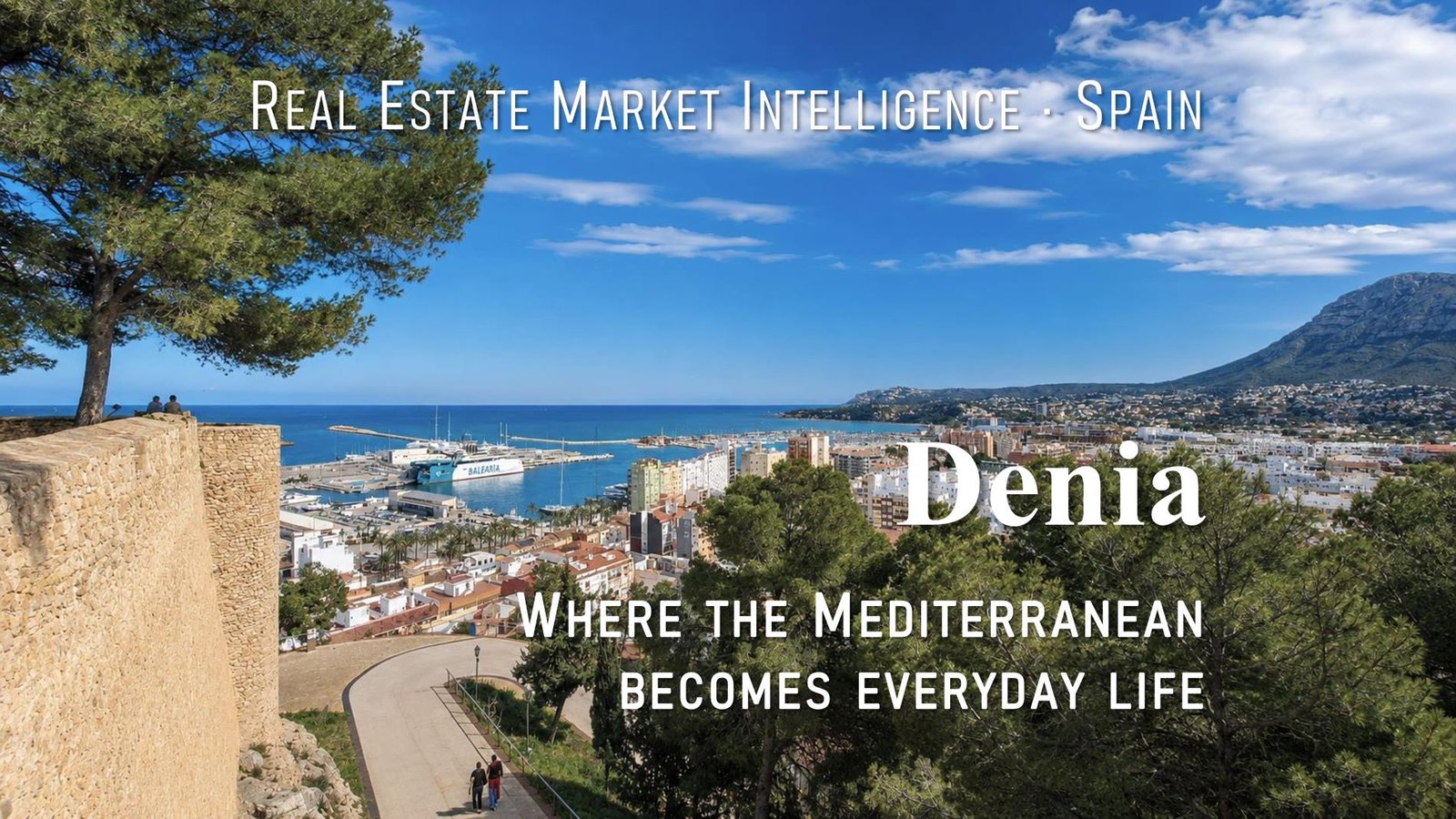
Occupying the northernmost stretch of Alicante Province, Dénia sits where Costa Blanca gradually transitions towards Valencia. It is the administrative centre of La Marina Alta, the comarca it shares with 32 other municipalities, and enjoys a strategic position between Valencia and Alicante, sheltered by the Montgó Natural Park and facing the Balearic Islands.

Unlike many Mediterranean coastal destinations that developed primarily around tourism, Dénia has always functioned as a genuine regional capital. Its commercial activity, administrative services, ferry connections and healthcare infrastructure create an urban rhythm that continues long after the summer season has ended, and radiate outward to neighbouring towns such as Jávea, Ondara, Pedreguer and La Xara.
Lifestyle, landscape & outdoor living
Its appeal lies in balance rather than spectacle.
The town combines a working fishing port with two marinas, a lively historic centre, long sandy beaches to the north and the rocky coves of Les Rotes to the south. Rising immediately behind the town, the Montgó Natural Park provides a dramatic backdrop while protecting one of the area’s most distinctive landscapes.
Outdoor living naturally becomes part of everyday life. Residents divide their leisure between sailing, paddleboarding, hiking, cycling, diving and evenings spent on waterfront terraces rather than organised resort activities. The nearby La Sella Golf Resort adds another dimension for golf enthusiasts, while tennis, padel and equestrian facilities are available throughout the municipality and neighbouring Pedreguer.
Food also plays an unusually important role in Dénia’s identity. Recognised by UNESCO as a Creative City of Gastronomy, the town has developed a culinary reputation that extends well beyond tourism, supported by its fishing tradition, local agriculture and an increasingly sophisticated restaurant scene.
Rather than feeling seasonal, Dénia feels lived in.
Living in Dénia
For international buyers considering permanent relocation, everyday practicality matters as much as scenery.
Dénia offers one of the most complete service ecosystems in Costa Blanca North, including a modern regional hospital, extensive shopping facilities, public and private schools, reliable fibre connectivity and year-round public services. Valencia and Alicante airports are both accessible in around one hour by car, while regular ferry services connect the town with Ibiza and Formentera.
The result is a destination where remote professionals, retirees, families and second-home owners can all find the infrastructure required for daily life without depending on larger cities.
Neighbourhoods
No single neighbourhood defines Dénia.
The Historic Centre offers traditional streets, local commerce and year-round activity. Around the Port and Baix la Mar, maritime heritage blends with restaurants, marinas and contemporary apartments.
To the north, Les Marines provides kilometres of sandy beaches with apartments and villas popular among both holiday-home buyers and permanent residents. Les Rotes presents a very different atmosphere, characterised by low-density villas, rocky coves and direct access to protected natural areas.
Further inland, Montgó and La Pedrera-Vessanes attract buyers seeking larger plots, panoramic views and greater privacy while remaining only minutes from the town centre. Nearby La Xara offers a quieter village environment closely connected to Dénia’s services.
Each area reflects a different lifestyle rather than a different level of prestige.
Understanding the town
| Dimension | Assessment |
| Year-round living | ★★★★★ |
| Outdoor lifestyle | ★★★★★ |
| International integration | ★★★★☆ |
| Urban convenience | ★★★★☆ |
| Long-term residential appeal | ★★★★★ |
Dénia’s greatest strength is not excelling in a single category but consistently performing well across all of them. Few towns in Costa Blanca North combine urban services, natural surroundings, international appeal and residential stability with such balance.
Real estate market
The residential market continues to demonstrate remarkable resilience. According to Idealista, the average asking price reached €3,417/m² in June 2026, marking a new historical high after annual growth of 8.1%, with positive monthly and quarterly trends also remaining intact.
Demand is driven by a broad mix of Spanish buyers, international retirees, remote professionals and second-home purchasers. While premium villas in Les Rotes and Montgó continue attracting high-end international demand, apartments close to the port and beaches remain particularly active thanks to their year-round usability.
Dénia · Residential market snapshot (2026)
| Market profile | Mature year-round international residential market |
| Average asking price | Above Alicante Province average |
| Premium residential areas | Les Rotes, El Montgó, Port, frontline Les Marines |
| Buyer profile | International lifestyle buyers, retirees, remote professionals, second-home owners and long-term investors |
| Foreign demand | High |
| Non-resident purchases | Strong, particularly in coastal neighbourhoods and premium villa areas |
| New build vs. resale | Demand remains strong for both. New development is concentrated in selected expansion areas, while established neighbourhoods rely primarily on resale stock. |
| Supply balance | Demand continues to exceed supply in the municipality’s most established residential locations, particularly detached villas and quality apartments close to the sea. |
| Property pricing | Asking prices range from around €2,500/m² in parts of the town centre to almost €4,000/m² in Les Marines, while premium villas in Les Rotes and selected Montgó locations frequently exceed €6,000–7,000/m², depending on views, plot and proximity to the sea. |
| Market Momentum Index (MMI) | 📈 Evolving (60/100). Dénia continues to display healthy market momentum supported by resilient international demand, limited supply and prices that have recently reached a new historic high. Growth has moderated compared with the strongest post-pandemic period but remains consistent across monthly, quarterly and annual horizons. |
| Rental market yields | Typically 3.5–5% gross, depending on location and property type. Lower yields than Alicante City mainly reflect higher acquisition prices rather than weaker rental demand. |
| Typical property types | Apartments, penthouses, detached villas, townhouses, fincas and golf properties nearby (La Sella). |
Dénia · Residential submarkets · June 2026
| Market | Asking price | Monthly | Quarterly | Annual | MMI |
| Spain | €2,823/m² | +1.0% | +4.2% | +15.8% | 83 · 🔥 Very Dynamic |
| Alicante Province | €2,834/m² | +0.8% | +3.7% | +10.3% | 74 · 📈 Evolving |
| Dénia (overall) | €3,417/m² | +0.4% | +2.7% | +8.1% | 60 · 📈 Evolving |
| Centro Urbano | €2,525/m² | +0.6% | −5.0% | −1.3% | ≈40 · ➡ Stable |
| Port | €3,578/m² | +0.4% | 0.0% | +4.9% | ≈56 · ➡ Stable |
| El Montgó | €3,533/m² | +2.4% | +6.5% | +13.8% | ≈72 · 📈 Evolving |
| Les Marines | €3,982/m² | +0.5% | +2.4% | +13.0% | ≈67 · 📈 Evolving |
| Les Rotes¹ | €3,439/m² | −0.3% | +5.0% | −7.1% | ≈45 · ➡ Stable¹ |
| La Pedrera–Vessanes | €3,307/m² | 0.0% | +6.5% | +17.4% | ≈73 · 📈 Evolving |
| Devesses–Monte Pego | €3,186/m² | +1.1% | −2.7% | +0.2% | ≈50 · ➡ Stable |
| La Xara–La Sella | €2,812/m² | +1.5% | +5.8% | +3.1% | ≈56 · ➡ Stable |
| Saladar | €2,327/m² | +1.2% | +3.4% | +11.2% | ≈66 · 📈 Evolving |
¹ Les Rotes remains one of Dénia’s most prestigious residential locations. The lower MMI does not indicate structural weakness but reflects a temporary correction after reaching historic highs in a very low-volume premium market, where individual transactions can significantly influence asking-price statistics.
The comparison illustrates another important feature of the Market Momentum Index (MMI): residential prestige, price level and market momentum do not necessarily move together. Les Rotes remains one of Dénia’s most exclusive residential environments despite showing more moderate momentum after reaching record prices, while areas such as La Pedrera–Vessanes currently exhibit stronger momentum driven by sustained demand and comparatively greater room for price appreciation. By combining price trends with proximity to historic highs, the MMI provides a broader view of market dynamics than price evolution alone.
Who will feel at home here?
Excellent choice for:
✔ Buyers seeking year-round living rather than purely seasonal use.
✔ International families looking for services, healthcare and outdoor lifestyle.
✔ Retirees who value walkability and everyday convenience.
✔ Sailing, cycling and gastronomy enthusiasts.
✔ Investors prioritising long-term capital preservation over speculative growth.
Possibly less suitable for:
✖ Buyers seeking a resort atmosphere or intensive nightlife.
✖ Investors focused primarily on maximum short-term rental yields.
Panea Scheffer’s perspective
Many destinations become attractive because they excel in one particular aspect.
Dénia succeeds because it rarely forces buyers to compromise.
It combines a functioning town, an established international community, excellent healthcare, protected landscapes, strong gastronomy and a mature residential market within a remarkably compact area.
That combination helps explain why demand has remained resilient through different market cycles and why Dénia continues to appeal not only to holiday-home buyers but increasingly to those relocating permanently.
Choosing Dénia is therefore rarely about finding the most spectacular property. More often, it is about choosing a place that continues to make sense long after the holiday has ended.
Beyond FAQ, people also ask:
Yes. Unlike destinations that rely primarily on seasonal tourism, Dénia functions as a genuine regional centre, with a hospital, schools, year-round retail and public services that support permanent residents as much as second-home owners.
There is no single “best” area (the right choice depends on lifestyle priorities). Buyers seeking beachfront living often look at Les Marines, those wanting privacy and views consider Montgó or La Pedrera-Vessanes, while Les Rotes remains the preferred choice for low-density, exclusive coastal properties.
No. As of June 2026, Dénia’s average asking price stood at €3,417/m², below Jávea’s €4,118/m², according to Idealista data. The gap is even wider in premium areas, where Jávea’s established international market commands some of the highest prices in Costa Blanca North.
The two markets sit close together. Dénia’s average asking price (€3,417/m²) is slightly below Calpe’s (€3,567/m²) as of June 2026, according to Idealista data. Prices in both towns vary considerably by neighbourhood, so location within each municipality often matters more than the town-level average.
Yes, in practice. Dénia’s long-established international community (British, Dutch, German, Belgian and French residents) supports multilingual healthcare, schooling and professional services, though basic Spanish remains useful for everyday administrative matters.
Both airports are approximately one hour away by car (around 105 km to Alicante and 110 km to Valencia), making Dénia practical for international owners who divide their time between countries.
Dénia’s market reached a historic price high in June 2026, with resilient demand and limited supply, according to Panea Scheffer’s Market Momentum Index. Momentum varies by neighbourhood (La Pedrera-Vessanes shows stronger growth potential, while Centro Urbano remains more stable), so timing depends as much on location as on the wider market.
Methodology & Sources
Market observations are based on publicly available asking-price data, official demographic statistics and Panea Scheffer’s proprietary residential market analysis.
Primary sources include INE, Idealista Data, Generalitat Valenciana and local public institutions where appropriate.



Join The Discussion