
Real Estate Market Intelligence & Investment Advisor
Costa Blanca · Spain
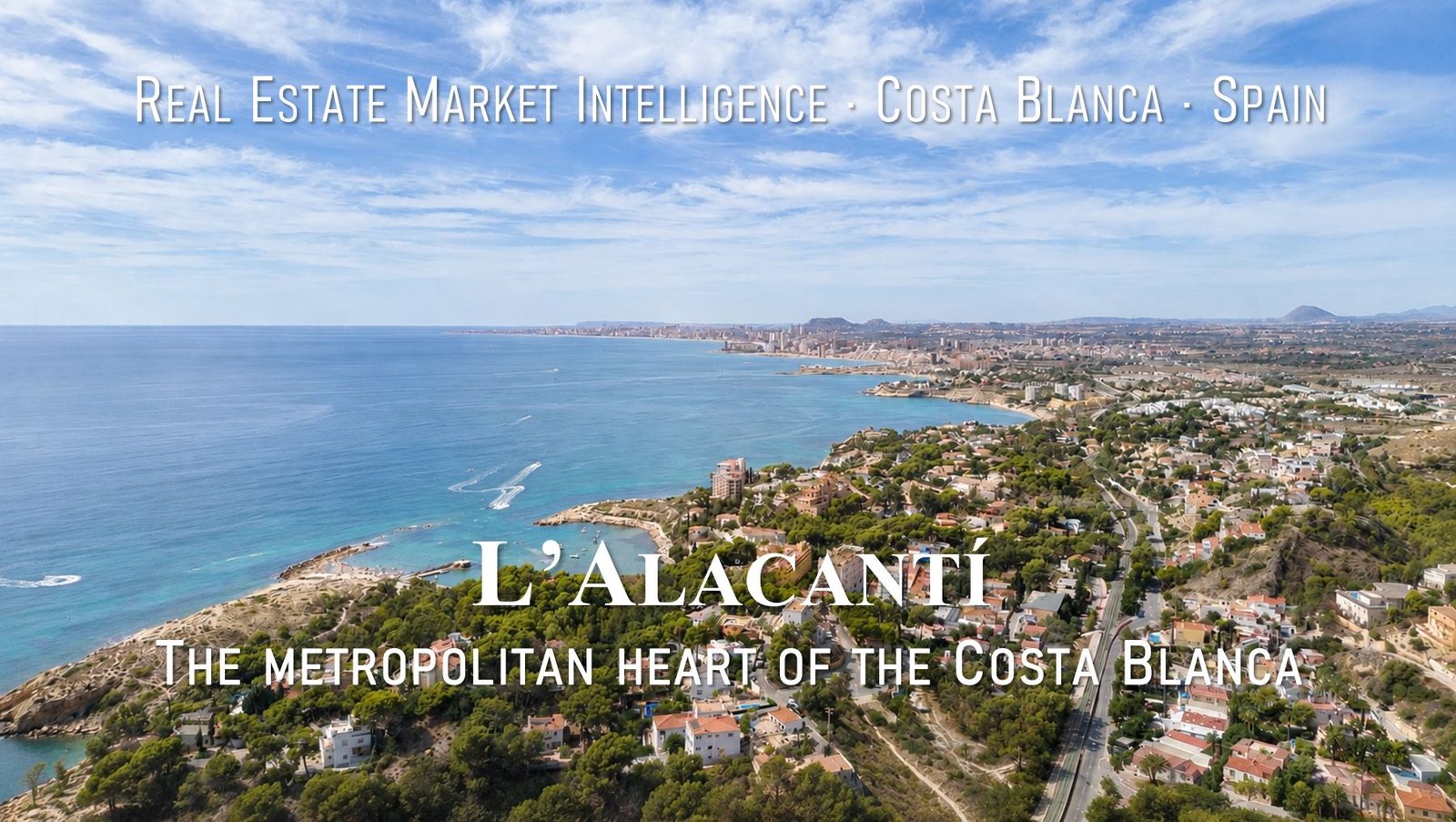
Many international buyers know Alicante city, but far fewer are familiar with L’Alacantí (also known as Campo de Alicante), the vibrant metropolitan comarca surrounding the provincial capital. Stretching from prime Mediterranean coastline to mountain villages, this region concentrates the economic, educational, and lifestyle core of the Costa Blanca. Whether you are looking for coastal living, family suburbs, or strategic investments, understanding this metropolitan area is the essential first step before buying property near Alicante.
💡 Key takeaways for property buyers
- 10 Complementary Municipalities: Integrates urban Alicante, coastal hot spots like El Campello, fast-growing suburbs (Mutxamel, Sant Joan), and tranquil mountain towns like Busot and Xixona within 15-40 minutes.
- Balanced & Resilient Demand: Driven by permanent residents, remote workers, university demand, and international buyers, making it significantly less seasonal than other Costa Blanca areas.
- Broad Price Spectrum: Offers luxury beachfront properties (PAU 5, Cabo Huertas at ~€3,800–€4,900/m²), robust mid-tier suburbs (~€2,000–€2,200/m²), and highly accessible inland options under €1,000/m².
- Unmatched Connectivity: Direct access to Alicante-Elche International Airport, high-speed AVE train to Madrid, TRAM light rail network, and top healthcare hubs.
📌 Short on time? Bookmark or save this page to reference our detailed municipality-by-municipality pricing and lifestyle guide when narrowing down your property search.
L’Alacantí (Campo de Alicante) at a glance
| Province | Alicante |
| Autonomous Community | Valencian Community |
| The comarca is known as | L’Alacantí (official name in Valencian) or Campo de Alicante (Spanish) |
| Main municipality | Alicante / Alacant |
| 10 Municipalities | Agost, Aigües (Aguas de Busot), Alicante, Busot, El Campello, Mutxamel, Sant Joan d’Alacant (San Juan), Sant Vicent del Raspeig (San Vicente), La Torre de les Maçanes (Torremanzanas) and Xixona (Jijona) |
| Population (approx.) | 530,000+ |
| Highest point | Cabeçó d’Or (1,209 m) |
| Economic profile | Administration, services, commerce, tourism, higher education, technology, food production, ceramics and local industry |
| International profile | High, particularly in Alicante and the coastal municipalities |
| Typical property markets | Primary residences, second homes, urban apartments, villas, coastal homes and investment properties |
Where is L’Alacantí? Map & location in the Alicante area

L’Alacantí (Campo de Alicante) occupies a strategic position in the centre of Alicante Province, stretching from the Mediterranean coastline inland towards the first mountain ranges that separate the coast from the inland comarcas.
It borders La Marina Baixa to the north-east, L’Alcoià to the north, Vinalopó Mitjà inland, and Baix Vinalopó to the south-west. To the east, its coastline follows the Mediterranean from Alicante city through Playa de San Juan to El Campello.
The comarca takes its official Valencian name, L’Alacantí, from Alicante itself (Alacant in Valencian). In Spanish it is traditionally known as Campo de Alicante, a historical name referring to the agricultural plain that surrounded the provincial capital. Today, L’Alacantí is the official administrative designation used by the Generalitat Valenciana, while Campo de Alicante remains widely recognised in everyday use.
This dual identity reflects the comarca itself. Alicante is unquestionably its administrative, economic and cultural centre, yet the surrounding municipalities each contribute a distinct residential character, from consolidated coastal communities and suburban family neighbourhoods to traditional inland villages framed by mountains and pine forests.
Its proximity to the Alicante-Elche international airport provides L’Alacantí with excellent connectivity, with most municipalities within around 15 to 40 minutes by road.
Where to buy property in the Alicante area: coast, suburbs & inland
Despite its relatively compact size, L’Alacantí encompasses three distinct residential environments.
The coast. Alicante, Playa de San Juan and El Campello combine established urban infrastructure with beaches, marinas and year-round services, attracting a broad mix of permanent residents, second-home owners and international buyers.
The inner suburbs. Mutxamel and Sant Joan d’Alacant, together with university-anchored Sant Vicent del Raspeig (San Vicente), have grown into some of the comarca’s most desirable residential areas: villas, modern developments and family housing within easy reach of the city and the coast.
The inland villages. Busot, Xixona, Agost, Aigües and Torremanzanas reveal a quieter, mountain-framed side of the comarca, with lower-density development and a more traditional pace of life.
Together, these differences are why L’Alacantí works best as several complementary markets rather than one, connected by shared infrastructure and a common economic centre. The detail behind each environment is set out town by town further below.
Climate, landscape and outdoor living
Like much of the Costa Blanca, L’Alacantí enjoys a Mediterranean climate characterised by mild winters, warm summers and approx 360 sunshine days throughout the year. Coastal municipalities benefit from sea breezes that temper summer and winter temperatures, while inland villages experience a slightly more continental climate, with cooler winter nights and warmer, yet dryer summer afternoons.
The landscape changes remarkably over short distances. Wide sandy beaches and urban promenades give way to fertile plains, dry river valleys, pine forests and mountain ranges dominated by the Cabeçó d’Or, whose distinctive silhouette has become one of the comarca’s defining natural landmarks.
This geographical variety supports an equally diverse outdoor lifestyle. Sailing, paddleboarding, swimming and beach sports define everyday life along the coast, while hiking, mountain biking, climbing and nature trails become increasingly prominent inland. Several golf courses add to the area’s recreational offer, along with traditional sports such as football, basketball, tennis, and a cultural offer that ranges from museums, music auditoria and theatres to open air concerts and seasonal events.
Unlike destinations driven primarily by seasonal tourism, outdoor living in Campo de Alicante is woven into everyday life. Beaches, parks, promenades and mountain trails are enjoyed throughout the year by local residents as much as by visitors, reinforcing the comarca’s appeal as a place not only to spend holidays, but to establish a permanent home.
Infrastructure and accessibility in Alicante Comarca
One of L’Alacantí’s defining strengths is not simply its location, but the concentration education, healthcare, public services and a mature transport network within a relatively small area. For buyers intending to relocate permanently, this often proves more important than proximity to the beach alone.
Alicante serves as the province’s principal administrative and commercial hub, concentrating many of its public institutions, hospitals, university and business services. Around the capital, the surrounding municipalities benefit from this shared metropolitan infrastructure while offering very different residential environments.
Higher education is centred around the University of Alicante, located in Sant Vicent del Raspeig, whose influence extends well beyond academia into research, innovation, cultural life and sustained residential demand across the metropolitan area. Alicante also hosts the headquarters of Distrito Digital Comunitat Valenciana, a regional government initiative to attract technology companies and digital talent.
Healthcare provision is among the most comprehensive in the province, with several major public hospitals in Alicante supported by an extensive network of private clinics that also cater for international residents.
Transport in Greater Alicante area
Road connectivity is excellent. The A-70 highway bypass links the metropolitan area with the A-7 Mediterranean Motorway, while the AP-7 provides fast access northwards to Valencia (up till the French border) and to the south towards Murcia. The N-332 continues to play an important role for coastal mobility, particularly between Alicante, Sant Joan d’Alacant, El Campello and further to Marina Baja and Marina Alta coastal towns.
Public transport is equally significant. Alongside an extensive bus network that covers all metropolitan areas, the TRAM Metropolitano de Alicante connects Alicante city with Playa de San Juan, El Campello, Benidorm and Dénia to the north, while additional lines serve Sant Vicent del Raspeig and the University of Alicante.
Although Alicante-Elche Miguel Hernández Airport is located in the neighbouring comarca of Baix Vinalopó, its proximity places international air connections within convenient reach of every municipality in L’Alacantí. Together with the Port of Alicante (ferry services and one of Spain’s busiest cruise terminals) and the city’s high-speed rail (AVE) connections to Madrid, the comarca enjoys one of the best-connected positions on Spain’s Mediterranean coast.
Approximate travel times
| Municipality | To Alicante city centre | To airport* | To Port of Alicante |
| Alicante | — | 15 min | — |
| El Campello | 20 min | 25 min | 25 min |
| Mutxamel | 15 min | 25 min | 20 min |
| Sant Joan d’Alacant | 15 min | 25 min | 20 min |
| Sant Vicent del Raspeig | 10 min | 20 min | 15 min |
| Busot | 25 min | 35 min | 30 min |
| Xixona | 30 min | 40 min | 35 min |
| Agost | 25 min | 20 min | 30 min |
| Aigües | 35 min | 40 min | 40 min |
| La Torre de les Maçanes (Torremanzanas) | 45 min | 55 min | 50 min |
*Alicante-Elche Miguel Hernández Airport, located in El Altet (municipality of Elche, Baix Vinalopó). Journey times are indicative and vary by starting point, season and traffic.
Choosing where to live in the Alicante area
L’Alacantí offers an unusual range of residential environments within a short travelling distance. Rather than asking which municipality or neighbourhood is “best”, buyers are generally better served by identifying the lifestyle they want to lead on a daily basis.
As throughout this series, the right location depends less on the property itself than on how well the surrounding environment matches your priorities. Before narrowing your search, consider questions such as:
- Do you expect to live in the property year-round or mainly during holidays?
- Is proximity to the beach more important than access to services?
- How much do daily commuting times matter?
- Would you prefer an urban apartment, a suburban villa or a traditional village house?
- Are international schools, healthcare or public transport likely to play an important role in your decision?
- Is long-term appreciation, rental potential or personal lifestyle your primary objective?
The profiles below answer these questions municipality by municipality.
L’Alacantí (Campo de Alicante), town by town
Although geographically compact, the Alicante comarca encompasses remarkably different residential environments. From Spain’s eleventh-largest city to small mountain villages with fewer than a thousand inhabitants, each municipality contributes its own character to the comarca’s residential landscape, complementing rather than competing with its neighbours.
Alacant (Alicante)

As the provincial capital, Alicante is the economic, administrative and cultural centre of the Costa Blanca. It is home to the largest concentration of employment, public services, shopping, healthcare, higher education and leisure facilities in the province, making it the natural choice for many buyers seeking an urban lifestyle.
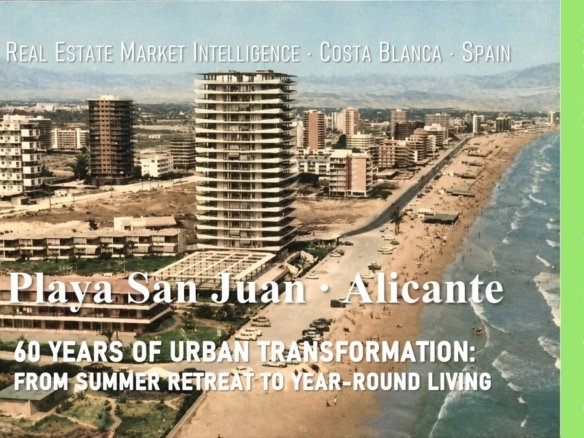
Residential areas range from the historic centre around the Santa Barbara Castle and waterfront districts to established neighbourhoods, modern developments and the highly sought-after Playa de San Juan and Cabo de las Huertas, where beachfront living combines with year-round services.
The city’s size means that purchasing decisions are often driven as much by neighbourhood as by municipality, a subject we explore in a dedicated Alicante guide.
El Campello

Stretching along one of the comarca’s longest coastlines, El Campello combines sandy beaches, a marina, residential developments and a traditional fishing heritage. While tourism plays an important role, it has also become a well-established year-round residential town, particularly attractive to buyers seeking coastal living without the scale of Alicante city. Its direct TRAM connection to Alicante and the Northern Comarcas further strengthens its appeal for both permanent residents and second-home owners.
Sant Joan d’Alacant (San Juan)
Small in size but highly regarded as a residential location, Sant Joan offers a predominantly urban environment with excellent healthcare, schools and local services. Its proximity to Playa de San Juan and Alicante city makes it particularly attractive to families and professionals looking for a quieter setting while remaining closely connected to the city.
Mutxamel (Muchamiel)
Immediately inland from Sant Joan and El Campello, Muchamiel has experienced sustained residential growth over recent decades. Spacious villas, established urbanisations, golf communities and newer housing developments make it one of the comarca’s most diverse residential markets. Many residents commute daily to Alicante, reflecting the municipality’s close integration with the metropolitan area.
Sant Vicent del Raspeig (San Vicente)
Home to the University of Alicante, San Vicente combines academic life with a strong local economy and excellent transport connections. Beyond its student population, it has developed into a mature residential municipality with a broad mix of permanent residents, local businesses and family housing, supported by its position close to Alicante city and major road networks.
Busot
Dominated by the imposing Cabeçó d’Or mountain, Busot offers a markedly different environment from the coastal municipalities. Detached villas, lower-density development and proximity to nature attract buyers seeking tranquillity while remaining within easy reach of Alicante and El Campello. The municipality is also well known for the Canelobre Caves, one of the province’s most significant natural attractions.
Xixona (Jijona)

Internationally recognised as the birthplace of turrón (traditional almond and honey confection typical in Christmas) in winter and ice-cream in summer, Xixona retains a strong manufacturing tradition while offering a quieter inland lifestyle. Its elevated position provides expansive mountain and distant sea views and a noticeably different atmosphere from the coast, attracting buyers who value authenticity, local character and more accessible property prices.
Agost
Agost has long been associated with ceramics and pottery, a tradition that continues to shape the town’s identity today. Surrounded by open countryside, it appeals to buyers looking for a traditional Spanish environment within practical commuting distance of Alicante.
Aigües (Aguas de Busot)
Aigües is one of the comarca’s smallest municipalities and enjoys an attractive hillside setting overlooking the Mediterranean in the distance. Historically known as a spa destination, today it attracts buyers seeking peace, nature and a slower pace of life while remaining relatively close to the coast.
La Torre de les Maçanes (Torremanzanas)
The comarca’s highest municipality offers a distinctly rural environment, surrounded by mountains and forests. With a small population and traditional character, it appeals to buyers who prioritise countryside living over proximity to the coast, illustrating the remarkable diversity that characterises L’Alacantí.
International community
L’Alacantí is one of the most internationally diverse areas of Alicante Province, although its foreign population is distributed unevenly across the comarca.
In Alicante, foreign nationals account for around 15% of the registered population, not counting the second and third generation born Spanish from residents of diverse origins. The city hosts a particularly diverse international community, including large numbers of residents from Colombia, Morocco, Italy, Romania, Ukraine, Venezuela and Argentina, alongside long-established British, Dutch, Belgian, French and other European communities. Unlike many coastal destinations, this diversity is driven not only by lifestyle migration but also by employment, higher education and business.
Along the coast, El Campello has an even stronger international profile, with foreign nationals representing around one quarter of the population, traditionally dominated by residents from the Netherlands, United Kingdom, Belgium, France, Germany and the Nordic countries, drawn by its year-round lifestyle, beaches and connections with Alicante.
Elsewhere, municipalities such as Busot, Aigües and Torremanzanas have established international communities, particularly among northern European buyers seeking detached homes in quieter surroundings, while Xixona and Agost retain a more predominantly Spanish character.
Together, these communities contribute to a residential market that remains active throughout the year and is considerably less seasonal than in many other areas of the Costa Blanca.
Residential market snapshot (2026)
L’Alacantí’s residential market differs from many other Costa Blanca comarcas in one respect: demand is not driven mainly by second homes or international buyers. As the province’s administrative, economic and educational centre, the comarca supports permanent residents, professionals, students, retirees, investors and holiday-home buyers within the same market.
This produces several distinct sub-markets rather than one, from the metropolitan core in Alicante city to the established second-home markets along the coast and the more accessible inland towns, though each follows its own dynamics. Taken together, the comarca benefits from a relatively balanced demand profile, less dependent on seasonality than many other parts of the Costa Blanca.
| Market profile | Metropolitan, residential and coastal |
| Primary demand | Permanent residence, second homes and investment (Build-to-Rent, student housing, tourist accommodation, mixed-use residential) |
| International buyers | Relatively high, particularly in Alicante and El Campello |
| Property types | Urban apartments, beachfront homes, villas, townhouses and country properties |
| Most dynamic markets | Alicante, El Campello, Mutxamel, Sant Joan d’Alacant |
| Lifestyle profile | City, coast and countryside within one metropolitan area |
| Market maturity | Established and diversified |
Property Prices in L’Alacantí: How Much Does Housing Cost Near Alicante?
Property values across L’Alacantí reflect the comarca’s diversity. Coastal municipalities generally command the highest asking prices, while inland towns continue to offer some of the most accessible housing opportunities within commuting distance of Alicante.
The strongest annual price growth is currently found in municipalities such as Xixona, Mutxamel and Sant Vicent del Raspeig, illustrating how demand is expanding beyond the traditional coastal markets. Meanwhile, Alicante and El Campello continue to demonstrate the resilience expected of mature residential markets supported by a broad and diversified buyer base.
As throughout this series, our Market Momentum Index (MMI) combines monthly, quarterly and annual price movements into a single indicator, helping identify whether local markets are cooling, stable or experiencing sustained upward momentum. It should not be interpreted in isolation, but alongside average asking prices.
Selected residential markets · Market Momentum Index (June 2026)
| Market | Av. asking price | Monthly | Quarterly | Annual | vs. historic max | MMI |
| Spain | €2,823/m² | +1.0% | +4.2% | +15.8% | At maximum | 83 · 🔥 Very dynamic |
| Alicante Province | €2,834/m² | +0.8% | +3.7% | +10.3% | At maximum | 74 · 📈 Evolving |
| Alicante city | €2,695/m² | −0.3% | +1.0% | +6.3% | At maximum | 37 · ⚠ Cooling |
| – Playa de San Juan – & Cabo Huertas | €3,832/m² | −0.4% | +1.0% | +6.9% | −0.4% | 39 · ⚠ Cooling |
| – PAU 5 | €4,933/m² | +0.3% | −2.6% | +16.1% | −2.6% | 73 · 📈 Evolving |
| El Campello | €3,184/m² | +0.2% | −0.2% | +6.7% | At maximum | 34 · ⚠ Cooling |
| Mutxamel | €2,241/m² | +3.8% | +10.1% | +15.5% | At maximum | 74 · 📈 Evolving |
| Sant Vicent del Raspeig | €2,055/m² | +0.1% | +1.4% | +14.5% | At maximum | 60 · 📈 Evolving |
| Busot | €1,971/m² | −2.6% | −5.6% | +12.2% | −5.6% | 28 · ⚠ Cooling |
| Xixona | €998/m² | +1.7% | +10.2% | +29.3% | At maximum | 93 · 🔥 Very dynamic |
| Agost, Aigües, San Juan, Torremanzanas | n.a.* | — | — | — | — | — |
*Insufficient published data from Idealista at the time of writing.
L’Alacantí presents one of the most diverse residential markets on the Costa Blanca. While Alicante and El Campello remain relatively stable after years of sustained growth, Mutxamel and Sant Vicent del Raspeig continue to outperform the provincial average, reflecting strong demand for well-connected residential locations within the metropolitan area.
Xixona records the highest annual growth and the strongest MMI in the comarca. However, as with other smaller inland markets, its lower transaction volume means that price movements can be amplified by a relatively small number of listings. Busot provides an interesting contrast: despite solid annual appreciation, recent monthly and quarterly corrections suggest a more moderate pace following earlier gains.
Taken together, these figures illustrate why L’Alacantí should not be interpreted as a single property market. The comarca encompasses mature urban and coastal markets characterised by stability, alongside emerging residential locations where momentum remains considerably stronger.
What makes L’Alacantí different?
Every Costa Blanca comarca has its own identity. In L’Alacantí, that identity is defined less by tourism than by diversity.
This is a comarca where a provincial capital, established coastal communities, suburban residential areas and traditional inland villages coexist within a relatively small territory. Buyers can choose between beachfront apartments, city-centre living, golf communities, detached villas or mountain properties, all while remaining within easy reach of the same employment centres, hospitals, universities and transport infrastructure.
That diversity also creates a more balanced property market. While international lifestyle buyers remain an important part of demand, they are joined by local families, professionals, students, entrepreneurs and retirees, resulting in a residential market that is active throughout the year rather than primarily during the holiday season.
For many buyers, L’Alacantí offers something that few other Costa Blanca comarcas can: the opportunity to enjoy a Mediterranean lifestyle without giving up the advantages of living in Alicante province’s principal metropolitan area.
Who is this comarca best suited for?
L’Alacantí (Campo de Alicante) may be particularly well suited to buyers who:
- Want to relocate permanently while remaining close to employment, healthcare, education and public services.
- Value year-round living more than a purely seasonal holiday environment.
- Need excellent connectivity, whether through road, rail, public transport or nearby international flights.
- Are looking for diverse residential options, from city apartments and beachfront properties to family villas and rural homes.
- Plan to work remotely or run a business, benefiting from Alicante’s growing digital ecosystem and professional services.
- Want to balance lifestyle with long-term market resilience, rather than focusing exclusively on holiday-home locations.
Buyers whose priority is complete tranquillity or a predominantly resort-based lifestyle may find neighbouring comarcas such as La Marina Alta or parts of La Marina Baixa a better fit.
Those seeking an active urban environment combined with easy access to the coast will often find Campo de Alicante difficult to match.
Beyond FAQ, buyers also ask
Yes. Unlike some Costa Blanca areas where the market is dominated by holiday homes, Alicante city has a large permanent population supported by employment, universities, healthcare, public services and year-round amenities. This makes it particularly attractive to buyers relocating to Spain or planning to spend extended periods on the Costa Blanca.
There is no single answer. Alicante city suits buyers looking for an urban lifestyle, El Campello appeals to those prioritising the coast, while Mutxamel and Sant Joan d’Alacant are popular with families seeking more space. Buyers looking for a quieter environment often consider Busot, Aigües or Xixona. The best choice depends on lifestyle, budget and daily priorities.
As of June 2026, El Campello (€3,184/m²) records a higher average asking price than Alicante municipality (€2,695/m²). Some neighbourhoods within Alicante city, particularly Playa de San Juan, Cabo Huertas and PAU-5, command significantly higher prices than the municipal average, approaching €5,000/m².
International demand is strongest in Alicante city, El Campello, Playa de San Juan, Mutxamel and, increasingly, Busot, where buyers are attracted by the combination of lifestyle, accessibility and year-round services.
Yes. Alicante combines reliable fibre connectivity, a growing coworking scene and CET/CEST time zone alignment with most of Europe’s business hours, with the lifestyle advantages that already attract permanent residents (climate, cost of living relative to Madrid or Barcelona, and international flight connections). The city’s Distrito Digital initiative reinforces this further, and buyers increasingly consider properties suited to hybrid or fully remote work, particularly in Alicante city centre and Playa de San Juan.
Sant Vicent del Raspeig, home to the University of Alicante’s main campus, supports a consistent rental market driven by student demand, alongside the wider metropolitan population. Properties within walking distance of the campus tend to let reliably each academic year, making the area of particular interest to buyers focused on rental yield rather than lifestyle, though returns should always be assessed against purchase price and local rental regulation, not assumed occupancy alone.
Sources and further reading about Alicante Comarca
This article combines official demographic statistics, publicly available market data and local market knowledge.
- Instituto Nacional de Estadística (INE): municipal population, nationality and annual population statistics.
- Idealista/data: asking-price reports for Spain, Alicante Province, Alicante, El Campello, Mutxamel, Sant Vicent del Raspeig, Busot and Xixona (June 2026), including district-level data for Playa de San Juan, Cabo Huertas and PAU-5.
- Generalitat Valenciana (Portal Estadístic): comarca definitions, demographic context and territorial statistics.
- Autoridad Portuaria de Alicante: port infrastructure and passenger services.
- Universidad de Alicante: institutional and campus information.
- TRAM d’Alacant (FGV): metropolitan rail network.
- Panea Scheffer Market Momentum Index (MMI): proprietary methodology combining monthly (20%), quarterly (30%) and annual (50%) asking-price movements.
About this series
Real Estate Market Intelligence is an editorial series by Panea Scheffer exploring the Costa Blanca through data, geography and local market knowledge. Rather than focusing on individual properties, the series helps buyers understand the places behind them, because informed location choices are the foundation of successful property decisions.
Each article combines official statistics, market intelligence and local insight to provide an independent overview of one of Alicante Province’s comarcas, before exploring its municipalities in greater detail through dedicated location guides.
Join The Discussion