

The risks every seafront property buyer must know, and the formula savvy investors use to profit anyway
The pessimists call it a legal trap.
The analysts see a mispriced opportunity (if you know the formula).
The cautionary tale you need to hear first
Our partner lawyer recently pulled a client back from the brink. The deal looked perfect: a beachfront villa on the Costa Blanca, beautifully priced, photographed magnificently. Then the due diligence came in. The property sat firmly inside Spain’s Dominio Público Marítimo-Terrestre (DPMT) — the public maritime-terrestrial domain. The concession had 30 years left, no guaranteed renewal, and a demolition clause with zero compensation. The buyer walked away. Rightly so.
That case, shared here (with anonymized data and AI-rendered image), could save you from the same outcome.
But it also raises a question most commentators miss: what if someone else had known the right price to pay for those 30 years?
What if the pessimism itself creates the opportunity?
You don’t buy a concession at a freehold price. But at the right number, it can be an intelligently structured investment in Spanish coastal real estate.
What is Spain’s Ley de Costas — and why does it exist?
Spain’s Ley 22/1988, later revised by Ley 2/2013, established a framework to protect the coastline as a permanently public asset. The goal is legitimate: prevent the wholesale privatisation of Spain’s beaches, dunes, and foreshore. The mechanism, however, is brutal for anyone who owns — or wants to own — a property in the affected zones.
The law defines the DPMT and rings it with concentric layers of restriction. Within those layers, private ownership is replaced by time-limited administrative concessions. When the clock runs out, the building comes down — usually without compensation.
The four zones you need to understand
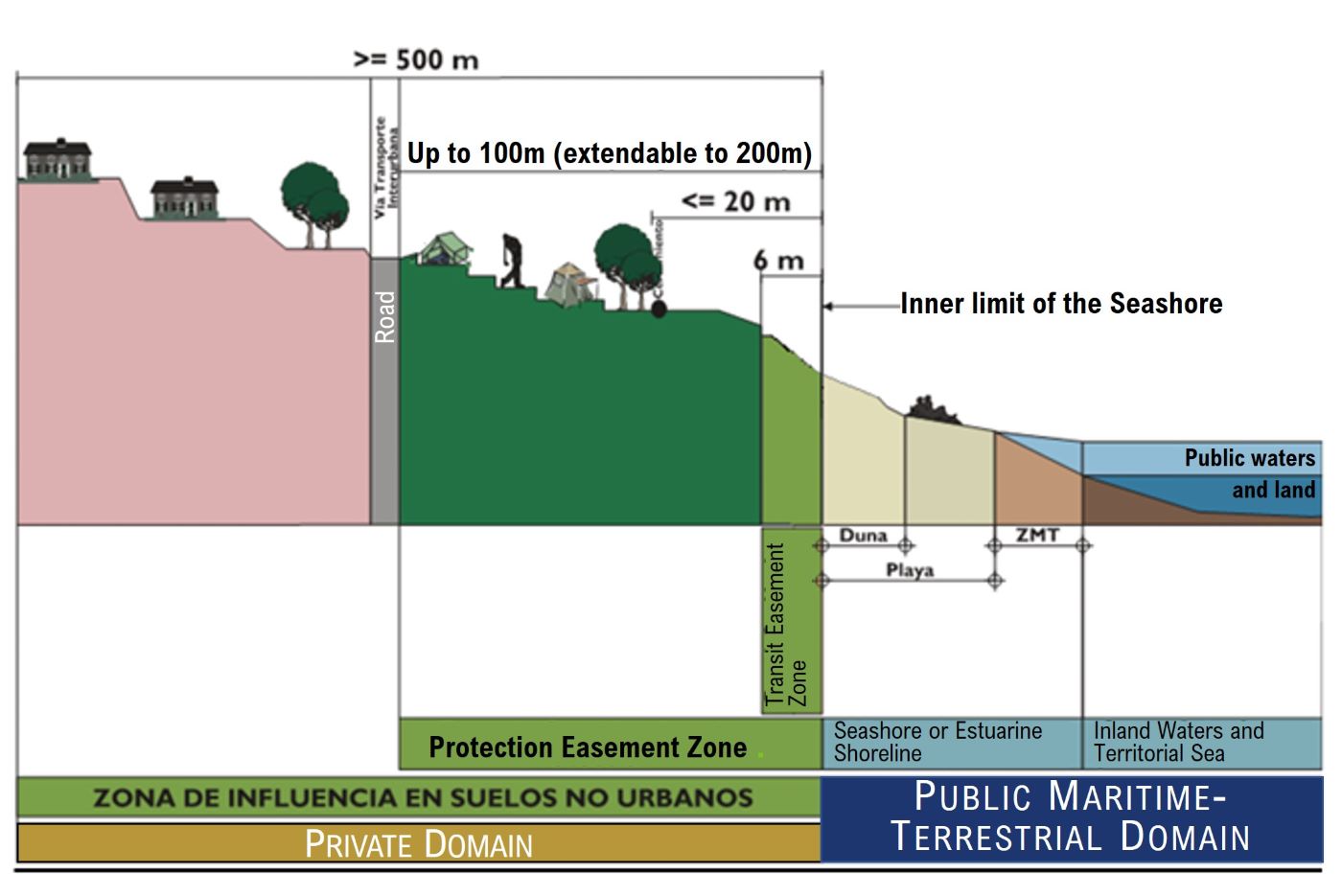
Zone 1: Dominio Público Marítimo-Terrestre (DPMT) (Public Maritime-Terrestrial Domain)
The seashore, beaches, dunes, reclaimed land, and tidal floodplain. This is the core public zone: private ownership replaced by temporary administrative concession. You are a tenant of the state, with a defined end date.
Zone 2: Servidumbre de Protección (Protection Easement)
A buffer strip of at least 100 metres inland (up to 200 metres in some areas). Private property can exist here, but construction is frozen. You cannot increase height, footprint, or volume. What you own, you own in amber.
Zone 3: Servidumbre de Tránsito (Transit Easement)
A 6-metre pedestrian corridor immediately beside the sea. Permanently public. No exceptions, no fences.
Zone 4: Zona de Influencia (Influence Zone)
Extends to 500 metres inland. Urban planning here must restrict density and prevent architectural barriers. New construction is permitted but tightly controlled.
| The key takeaway for buyers If your property falls within the DPMT, you are not a freeholder. You are a concessionaire — with all the rights and none of the permanence that ownership implies. If it falls within the Protection Easement, you own it — but cannot meaningfully develop it. If it is beyond 200 metres, your risks drop dramatically, though planning constraints still apply out to 500 metres. |
How concessions work: timeframes, fees, and what happens at the end
Concessions are granted by Spain’s Ministry for Ecological Transition (MITECO), following a formal administrative process that includes public notice and, in relevant cases, environmental assessment. Three categories govern time limits:
- Permanent or residential buildings: up to 50 years
- Environmental or conservation works: up to 75 years
- Temporary or demountable installations: maximum 30 years
Concession holders pay an annual canon (fee) to the state for use of public land. This is not a property tax — it is a rental charge. The concession is not freely transferable as a freehold property would be; it is a right of temporary use, assignable only under specific conditions.
The 2013 reform introduced the possibility of one-time extensions — but conditions are strict and the absolute ceiling is 75 years. At expiry, demolition is mandatory and the land must be restored to its natural state. Compensation is not automatic unless specifically written into the concession deed.
What types of properties are affected on the Costa Blanca?
Any structure on DPMT land is caught by this framework — villas, apartments, beach bars, marina installations, and land reclaimed from the sea. The key word is “any”: it does not matter whether the building was erected legally before 1988. Once the official boundary demarcation (deslinde) places a property inside the DPMT, the concession regime applies.
Across the Costa Blanca, every coastal municipality is subject to the same framework. From Dénia and Jávea in the north to Torrevieja, Santa Pola, and Orihuela Costa in the south — Altea, Calpe, Benidorm, Villajoyosa, Guardamar — all of it falls under the same national law. Local councils cannot override it.
| The scale of the problem in numbers 12,800 homes were regularised under the 2013 reform, converting what would have been immediate demolition orders into timed concessions. 140,000 additional structures were amnestied for previously illegal works. The total number facing eventual demolition as concessions expire — absent further legislative intervention — runs into the tens of thousands across Spain. No automatic compensation applies at expiry. |
How the law hits property values — and why that creates a market
The pricing impact is well documented and substantial. A property within the DPMT, or carrying a concession with meaningful remaining time, can trades at 30 to 75% discount to equivalent freehold properties in the same location. Three forces combine to produce this discount:
- Demolition risk — the probability-weighted cost of losing the structure at expiry without compensation
- Financing restrictions — most Spanish lenders will not mortgage a concession-based property, eliminating the majority of the buyer pool and compressing demand-side pricing
- Legal uncertainty — ambiguity around renewal creates a risk premium that rational buyers apply to any offer
Most commentators stop here and conclude: avoid these properties. That is the correct answer for the naive buyer and the wrong answer for the analytical investor. The same discount that makes these properties dangerous at the wrong price makes them deeply interesting at the right one.
The mistake is not buying a concession property. The mistake is paying a price that does not reflect the finite nature of what you are actually acquiring.
The investor calculator: What is the maximum price worth paying
A concession property is, in financial terms, a time-limited income-producing asset with a fixed terminal date and zero residual value (unless legislation changes, which is a policy option, not a contractual right).
The correct analytical lens is not real estate — it is a depreciating leasehold with embedded rental income potential.
The calculator below allows an investor to estimate the maximum rational acquisition price (P) for a concession property, given the required rate of return (R) and the number of years remaining on the concession (n).
What the formula does not cover — Know your limits
This framework assumes the concession runs to its stated term without forced early termination. It does not price the probability of early demolition ordered by a coastal authority, nor does it model the scenario where a new government extends all concessions by legislation. Both are possible. The formula gives you the base case; judgment and legal advice supply the scenario adjustments.
Important: This framework is provided for analytical illustration. It is not financial advice, legal advice, or a solicitation to buy any specific property. Any investment in a concession-based property requires qualified legal advice and independent financial assessment specific to the individual asset. Always verify concession status, remaining term, and canon obligations with MITECO before proceeding.
Due Diligence: The checks you cannot skip
Whether you are running the investor formula or simply protecting yourself as a buyer, the due diligence chain is the same. None of these steps is optional.
- Hire a lawyer or notary with demonstrated coastal law expertise — not a generalist, not a relative’s contact. This specialism matters.
- Verify the official coastline demarcation (deslinde) through MITECO or the relevant coastal demarcation office. The absence of a Land Registry annotation does not mean the property is free from restrictions.
- Request the full concession documentation: start date, expiry, annual canon amount, renewal terms, and any conditions attached.
- Check all planning and environmental clearances to confirm the structure was properly permitted.
- If investing, run the formula above against verified rental income figures — not estimates from an optimistic agent.
- Assess demolition and restoration costs with a local quantity surveyor.
| Critical warning on Land Registry entries Properties built before the 1988 Coastal Law may show no affectation in the Land Registry — the deslinde may not yet have been registered or communicated. The absence of a registry entry is NOT confirmation that the property is free from Coastal Law restrictions. A buyer who discovers the affectation after purchase will generally have no recourse against the seller unless bad faith can be proven — which is difficult in practice. Always request a specific Coastal Demarcation Office report (Informe de Costas) as part of standard due diligence. |
Compensation, European pressure, and the legislative wildcard
The compensation question is the one that most directly affects whether the formula changes. Under current Spanish law, there is no automatic right to compensation at concession expiry or demolition. The European Parliament has urged Spain to pay fair market value to affected owners, but this has not been translated into binding domestic law.
Compensation is only available in narrow circumstances: early expropriation for a specific public interest project, where the state compulsorily acquires the concession ahead of schedule. This is uncommon. Any investor pricing in a compensation windfall is taking a speculative political bet, not deploying capital rationally.
The legislative wildcard — a future government extending all concessions by decree — is real but unquantifiable. Spain has modified this law once (in 2013) and political pressure from coastal municipalities is persistent. If you model it, do so as an upside scenario only.
The opportunity, stated plainly
The Costa Blanca’s most spectacular sea-view properties — front-row, water’s edge, unobstructed Mediterranean panoramas — include a meaningful number of concession assets. The market prices these at a discount that, in many cases, is not merely fair but irrational. The irrationality is structural: most buyers cannot mortgage them, most agents do not understand them, and most sellers are motivated by urgency or complexity fatigue.
That combination produces the conditions for asymmetric investment: a well-defined downside (the formula), a predictable income stream (rental yield from sea-view scarcity), and an option on legislative upside (concession extension). The view does not expire when the concession does. For 20 or 30 years of unobstructed Mediterranean mornings, acquired at the right price, the returns can be compelling.
Buy the concession, not the fantasy. Price it correctly, rent it well, enjoy it fully — and exit before the clock runs out.
Q&A
No. Once classified within the DPMT, the ownership right is replaced by a temporary administrative concession. You are not a freeholder. You are a time-limited user of public land.
Ley 2/2013 permits one-time extensions where current urban and environmental conditions are met. The absolute maximum duration is 75 years. Extensions are not automatic and cannot be assumed in investment calculations.
Under current law: yes. The concession holder must demolish and restore the site at their own cost. The only exceptions are early state expropriation (rare) and legislative change (possible but not guaranteed).
Request a specific report from the relevant Coastal Demarcation Office (Demarcación de Costas) via MITECO. Cross-reference with the official deslinde maps. Do not rely on Land Registry entries alone.
There is no universal number — the formula is the tool. The discount required is whatever produces your target return over the remaining concession period after accounting for annual canon, operating costs, and demolition liability. In practice, for properties with 20–35 years remaining and strong rental fundamentals, the market discount often exceeds what the formula requires.
Before you sign anything
Whether you are protecting yourself as a buyer or deploying capital as an investor, the prerequisite is identical: specialist legal advice before commitment. A qualified coastal law lawyer will verify concession status, interpret the “deslinde” records, and flag conditions that no formula can replace.
Found this analysis useful? Share it with your network. Every year, buyers on the Costa Blanca sign contracts without understanding what they own, or what they will lose. The more people who understand this law, the fewer unnecessary disasters occur.
Have a specific case — a property you’re evaluating, a concession whose terms you want to stress-test? Leave a comment or reach out directly. We work with specialist legal advisors and can facilitate a dedicated analysis.
| Further Steps Check MITECO deslinde maps: miteco.gob.es — Costas section Request an official Informe de Costas before any coastal property purchase Read the full step-by-step buying guide at flamencos.eu/en/buying-property-alicante-2025/ Consult a lawyer — not optional, not avoidable, non-negotiable |
Important legal notice
This article is provided for informational and analytical purposes only. It does not constitute legal advice, financial advice, or a recommendation to buy or sell any property. The investor calculator presented is an illustrative analytical tool; individual investments require qualified independent legal and financial assessment. Coastal Law regulations and their application may change. Always verify current status with MITECO and qualified Spanish legal counsel before making any property decision.

Join The Discussion