
Real Estate Market Intelligence & Investment Advisor
Costa Blanca · Spain
Coastal living with the infrastructure of a city
There are places on the Costa Blanca where living by the sea means accepting a certain degree of seasonality. Playa de San Juan is not one of them.
Part of Alicante city itself, this long-established residential area combines Mediterranean coastal living with something many resort locations cannot offer quite as easily: the schools, healthcare, public transport, shops, restaurants, sports facilities and everyday services of a provincial capital.
That distinction matters to buyers.
Playa de San Juan can work as a second-home location, but it does not depend on the holiday season to function. For thousands of residents, it is simply home.
And from a property perspective, it is more diverse than the name suggests.
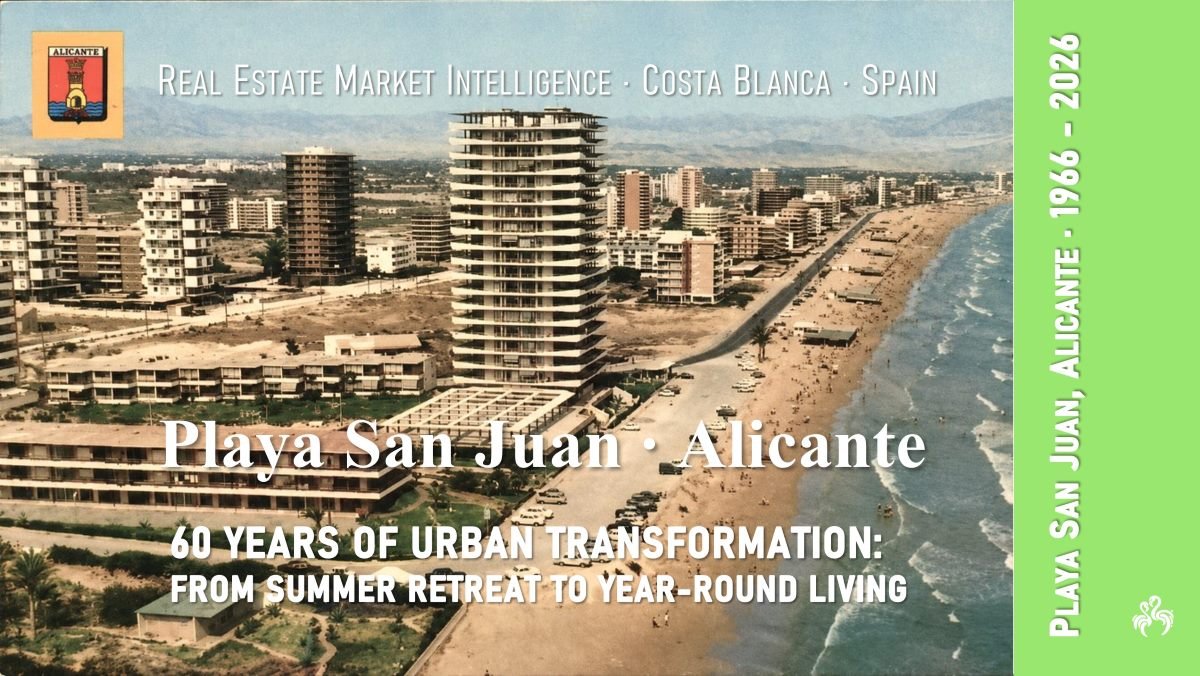
Playa de San Juan: More neighbourhood than resort

Playa de San Juan stretches along the northeastern edge of Alicante, adjoining Cabo de las Huertas and continuing towards Muchavista in neighbouring El Campello.
Its defining feature is, inevitably, the beach: a broad expanse of fine sand extending for almost seven kilometres when considered along its wider coastal continuation. But the residential district behind it has developed over several decades into a substantial urban environment in its own right. Alicante City Council itself describes Playa de San Juan as another residential neighbourhood of the city.
The result is an unusual combination.
The seafront and Avenida de Niza provide the recognisable Mediterranean setting, with restaurants, cafés and terraces running along and behind the promenade.
Move inland, however, and the urban fabric changes: supermarkets and everyday retail, schools, medical services, gyms, sports facilities, residential streets and large established developments increasingly replace the purely beachfront environment.
Further west, Alicante Golf introduced another residential landscape around its 18-hole course, designed by Severiano Ballesteros.
More recent development around PAU 5 has added a distinctly contemporary generation of apartments and residential complexes.
So although all of this is commonly described as “Playa de San Juan,” the experience — and the property market, can change considerably within a relatively short distance.
Living in Playa de San Juan year-round

This is perhaps Playa de San Juan’s strongest proposition.
For permanent residents, daily life does not require returning to central Alicante for every necessity. The area has supermarkets and local shops, pharmacies, restaurants, cafés, professional services and an established educational infrastructure, with public, private and concerted schools and secondary education available in this part of the city and its immediate surroundings.
Healthcare follows a similar pattern. Residents have access to the public primary healthcare network serving the Playa de San Juan–Cabo de las Huertas area, including the local Social Security health facilities, alongside private medical centres, dental practices, physiotherapy and clinics covering different specialities.
And when something more specialised is needed, this is still Alicante: the wider metropolitan area’s hospitals, universities, professional services, shopping centres and administrative infrastructure remain within easy reach.
That makes Playa de San Juan particularly relevant to buyers who like the idea of living on the coast but do not necessarily want to live in a resort.
Beach, sport and outdoor lifestyle
The beach is not merely scenery here.

Running and walking along the promenade form part of everyday life, while swimming, paddleboarding, windsurfing and other water sports extend activity onto the sea.
The municipal sports area on Avenida de Niza includes beach volleyball and futvolley courts, beach-tennis courts, beach football and beach-handball facilities, as well as outdoor fitness and calisthenics equipment.
Behind the beach, Alicante Golf adds an entirely different sporting environment. Its 18-hole, par-72 course was designed by Severiano Ballesteros and includes practice facilities and a golf school.
Tennis, padel, gyms and organised sports are also widely available in and around the district.
And immediately south, Cabo de las Huertas changes the landscape again: sandy beach gives way to rocky coves and crystal clear water, with walking and snorkelling opportunities along a coastline that feels remarkably different despite being only minutes away.
Restaurants, terraces and Alicante city life
Playa de San Juan has enough restaurant density to function independently as a dining destination.
The offer ranges from informal beachfront establishments and cafés to rice restaurants, Mediterranean cooking and more contemporary dining, with additional concentrations of restaurants and bars around the Golf and newer residential areas.
But perhaps more important for permanent residents is what lies beyond the neighbourhood.
Central Alicante remains close enough for dinner, shopping, theatre, concerts or an evening around the port without turning the outing into a day trip.
That relationship works in both directions: Playa de San Juan offers a coastal residential lifestyle while Alicante supplies the cultural and commercial depth of the city.
TRAM, airport and connections to Alicante
The TRAM is an important part of that equation.
Playa de San Juan and Cabo de las Huertas are served by the metropolitan tram network, providing public-transport connections towards central Alicante and northwards through the coastal corridor. Bus services complement the tram, while road connections provide relatively straightforward access to Alicante city, the A-70 metropolitan motorway network and the wider province.
For international owners, Alicante-Elche Miguel Hernández Airport is also close enough for Playa de San Juan to work convincingly as a second residence without making airport transfers a major logistical consideration.
Yet the more important point for permanent residents may be simpler: a car is useful, but depending on where within Playa de San Juan you live, it does not necessarily have to structure your entire daily life.
Playa de San Juan property market
A mature market, with a new-build exception, as the residential market tells an interesting story.
Selected residential markets · Market Momentum Index (June 2026)
| Market | Av. asking price | Monthly | Quarterly | Annual | vs. historic max | MMI |
| Spain | €2,823/m² | +1.0% | +4.2% | +15.8% | At maximum | 🔥 83 · Very dynamic |
| Alicante Province | €2,834/m² | +0.8% | +3.7% | +10.3% | At maximum | 📈 74 · Evolving |
| Alicante city | €2,695/m² | −0.3% | +1.0% | +6.3% | At maximum | ⚠️ 37 · Cooling |
| Playa de San Juan & Cabo Huertas | €3,832/m² | −0.4% | +1.0% | +6.9% | −0.4% | ⚠️ 39 · Cooling |
| PAU 5 | €4,933/m² | +0.3% | −2.6% | +16.1% | −2.6% | 📈 73 · Evolving |
Source: Idealista asking-price data, June 2026. MMI: Panea Scheffer Market Momentum Index.
The figures reveal two different stories.
Playa de San Juan and Cabo Huertas already command a substantial premium over Alicante city as a whole, but their current momentum is relatively subdued. At €3,832/m², average asking prices were just 0.4% below their historical maximum in June.
This is therefore not a low-priced or declining market.
Rather, the MMI indicates a mature market currently moving at a slower pace.
PAU 5 is the obvious exception.
At €4,933/m², its average asking price was almost 29% higher than Playa de San Juan–Cabo Huertas overall, while annual growth reached 16.1%. Its MMI of 73 places it firmly in the Evolving band.
But even those figures require context.
€3,832/m² does not describe a property
Few neighbourhood averages illustrate the limitations of €/m² as clearly as Playa de San Juan.
Current Idealista listings reviewed for this analysis show a market spanning relatively accessible apartments at around €150,000 – €200,000 at the lower end of current asking prices, through family apartments in established residential complexes in the €200,000s to €400,000s, to considerably more expensive contemporary apartments, townhouses and detached villas.
At the upper end, detached homes in the broader Playa de San Juan – Cabo Huertas market move comfortably into seven-figure asking prices, with exceptional villas marketed at several million euros.
Those are not statistical averages; they are examples from current advertised supply. But they demonstrate why the headline €/m² should never be interpreted as a valuation of an individual property.
Several generations of Playa de San Juan

Some of the area’s apartment complexes date from the 1970s and 1980s. Many occupy generous plots that would be difficult to reproduce under today’s development economics, with mature gardens, swimming pools, sports courts and substantial communal areas.
Their apartments may have undergone several generations of refurbishment, or none at all.
Later developments from the 1990s and 2000s introduced different layouts, construction standards, garages and communal facilities. More recent projects have brought contemporary architecture, energy efficiency, large terraces and the amenities now associated with premium new-build developments.
Townhouses introduce another segment, while detached villas, particularly towards Cabo de las Huertas and selected residential pockets, belong to a fundamentally different market again.
And PAU 5 has added yet another benchmark for contemporary apartment living.
Consequently, age alone does not determine value.
A beautifully renovated apartment in a well-maintained 30-year-old development with mature landscaping, excellent communal facilities and a strong location can represent a very different proposition from an ageing apartment in a poorly maintained complex of exactly the same period.
Equally, paying the premium for new construction does not automatically make it the better purchase.
Buying in Playa de San Juan: look beyond the apartment
This is particularly important in a market dominated by residential complexes.
Before comparing two apparently similar apartments, we would look at two assets, not one: the private property and the community it belongs to.
For the apartment itself, orientation, natural light, usable outdoor space, floor level, privacy, views, layout, construction quality, energy performance, noise and the quality, rather than simply the appearance, of any renovation all matter.
Then comes the building or urbanisation.
Its age and maintenance history can be more revealing than the date on the cadastral record. Façades, roofs, terraces, lifts, plumbing, electrical infrastructure, garages, accessibility and common installations should all be considered where relevant.
The same applies to the financial health of the community: community fees, reserve funds, approved or foreseeable derramas (outstanding works on the minutes of recent owners’ meetings) can materially change the economics of what initially looks like an attractive purchase.
And amenities need context too.
A large swimming pool, landscaped gardens, tennis or padel courts, children’s areas, gym, concierge or security may add considerable lifestyle value, but they also have to be maintained. Two urbanisations with apparently similar facilities can differ markedly in condition, management and running costs.
For older renovated apartments, particular attention should be paid to what was actually renovated. New flooring, kitchens and bathrooms are immediately visible; plumbing, electrical systems, windows, insulation and waterproofing are much less so.
With new construction, the questions change rather than disappear: developer track record, specifications, communal costs, orientation, future surrounding development and what is still planned for neighbouring plots deserve consideration.
Finally, location within Playa de San Juan itself matters.
Walking distance to the beach, proximity to a TRAM stop, schools or everyday services, traffic, restaurant activity, orientation towards communal areas, first-line exposure to wind and summer activity, and the quieter character of more internal streets can produce very different residential experiences within the same postcode.
Who does Playa de San Juan suit?

Perhaps its greatest strength is that the answer is not limited to one buyer profile.
It can work for families wanting schools, services and outdoor space; professionals who need proximity to Alicante; international buyers looking for a Mediterranean home that remains functional throughout the year; retirees who value healthcare and public transport; golfers and active buyers; or second-home owners who want more infrastructure than a traditional holiday destination provides.
It will not suit everyone. Buyers looking for historic architecture, village life or complete seclusion will find better matches elsewhere on the Costa Blanca.
But for those trying to reconcile the sea with the practical advantages of a city, Playa de San Juan occupies a relatively unusual position.
The beach may be what first attracts attention.
The fact that you can build an ordinary life around it is what makes Playa de San Juan a residential market.
Beyond FAQ, people also ask:
Is Playa de San Juan a good place to live all year round?
Yes. Unlike more seasonal coastal locations on the Costa Blanca, Playa de San Juan is part of Alicante city and functions as a permanent residential district, with year-round access to schools, healthcare, shops and public transport rather than services that scale up and down with the holiday season.
According to Idealista asking-price data for June 2026, Playa de San Juan and Cabo Huertas averaged €3,832/m², close to the area’s historical maximum. The Market Momentum Index places the area at 39 (Cooling), meaning prices remain high but momentum has slowed compared with the province overall. PAU 5, the newer development within the area, shows a different profile: €4,933/m² with 16.1% annual growth and an MMI of 73 (Evolving). These are averages, not valuations; the actual price of a given apartment or villa depends heavily on the building, the renovation and the exact location.
The seafront and Avenida de Niza become considerably busier in summer, particularly around the promenade and beach sports areas. Move further inland, towards the residential streets, Alicante Golf or PAU 5, and the seasonal effect is much less pronounced, since these areas function as everyday neighbourhoods rather than holiday destinations.
PAU 5 is a more recently developed sector to the west of the traditional Playa de San Juan area, built around contemporary apartment complexes rather than older beachfront developments. It currently commands higher average asking prices and stronger annual growth than the wider area, reflecting its newer construction standards and different buyer profile.
Playa de San Juan is connected to central Alicante by the metropolitan TRAM network and by bus and road, making the city centre a short journey rather than a separate destination. Alicante-Elche Miguel Hernández Airport is also close enough to keep transfer times manageable for owners using the property as a second residence.
Definitely yes. The area has public, private and concerted schools, secondary education options and paediatric and general healthcare services nearby, combined with beach access and organised sports. This combination makes it a practical option for families who want coastal living without sacrificing everyday infrastructure.
Beyond the apartment itself, orientation, light, layout and renovation quality, it is worth reviewing the building or urbanisation: age and maintenance history, community fees, reserve funds, any approved or foreseeable derramas (communal costs), and the condition of shared amenities such as pools or gardens. For older buildings, it is also worth understanding exactly what was renovated, since visible upgrades such as flooring or kitchens do not necessarily extend to plumbing, electrical systems or waterproofing.
Sources
Market and residential asking-price data: Idealista, June 2026. The published Idealista series provides the benchmark data used for Alicante, Playa de San Juan – El Cabo and PAU 5. Current listings reviewed on the portal were also used to illustrate the breadth of advertised property types and asking-price levels discussed in this article.
Information on Playa de San Juan, its beach, access and public transport was cross-checked against official sources from Alicante City Council, Alicante Tourism and the TRAM d’Alacant metropolitan transport network.
Healthcare information was checked against the Departamento de Salud Alicante – Sant Joan d’Alacant, including the public primary-care network serving Cabo de las Huertas and Playa de San Juan.
Education references were checked against Alicante City Council educational information, including the local network of public, concerted and private schools and secondary education.
Sports and lifestyle information was sourced from Alicante City Council, Alicante Tourism and Alicante Golf.
Property listings and asking prices change continuously. Examples of advertised properties mentioned in this article represent a snapshot of the market at the time of research and should not be interpreted as valuations or statistically representative market averages.
About this series
Local Insights looks beyond property listings to understand the places behind them.
The series explores the Costa Blanca at different levels, from comarca and municipality to neighbourhood and micro-location, combining residential market data with local knowledge, infrastructure, connectivity and the practical realities of living in each area.
Because two properties with similar characteristics can represent very different decisions depending on where they are located, understanding the market starts with understanding the place.
Continue exploring Costa Blanca
- Alicante’s 9 Comarcas | Costa Blanca buyer’s guide
- La Marina Alta | Costa Blanca
- La Marina Baja | Costa Blanca
- Alicante and surroundings | Greater Alicante Area
- Mid-Year Residential Market Report | Costa Blanca North
- Six decades of international Life on the Costa Blanca
Panea Scheffer · Real Estate Market Intelligence & Property Advisory · Costa Blanca, Spain


Join The Discussion